
- Buy Crypto
- Markets
 Futures
- Spot
- Copy Trade
 Earn
Earn- More
About the Ethereum Pectra Upgrade, Everything You Need to Know

Original Article Title: Everything you need to know about Pectra: the new Ethereum Upgrade
Original Article Author: @francescoweb3, Co-Founder of Castle Labs
Original Article Translation: zhouzhou, BlockBeats
Editor's Note: This article introduces the Pectra upgrade, a significant improvement to Ethereum, divided into three main areas: enhancing Ethereum accounts, improving validator experience, and expanding block data. The article details several Ethereum Improvement Proposals (EIPs), including EIP-7702, EIP-7251, among others, enhancing account functionality, reducing validator operational complexity, and increasing network efficiency. It also discusses how to scale the network by increasing block capacity and gradually achieving the goal of a stateless client, advancing the security and scalability of the Ethereum network.
The following is the original content (slightly reorganized for better comprehension):
Ethereum is improving its account functionality, streamlining network validation, and enhancing block efficiency. This article will introduce Pectra, this highly anticipated upgrade, which has brought many new Ethereum Improvement Proposals (EIPs), with the first phase already live.
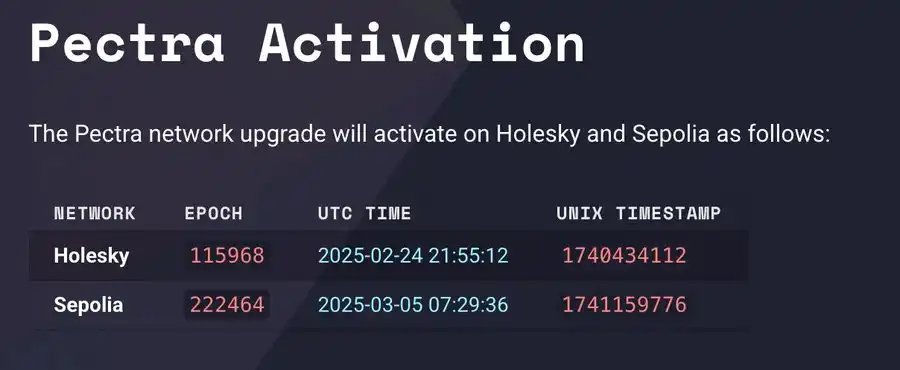
Live on Holesky on February 24
Live on Sepolia on March 5
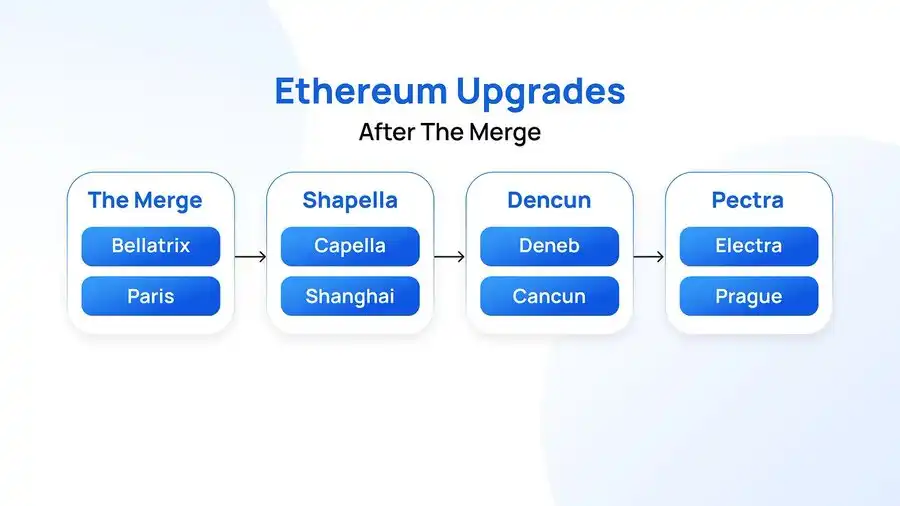
Once the implementation is successful, the mainnet update date will be determined. We can expect the mainnet update to take place between 3 to 9 months after the testnet implementation. Pectra is a rather significant upgrade, bringing improvements from multiple EIPs:
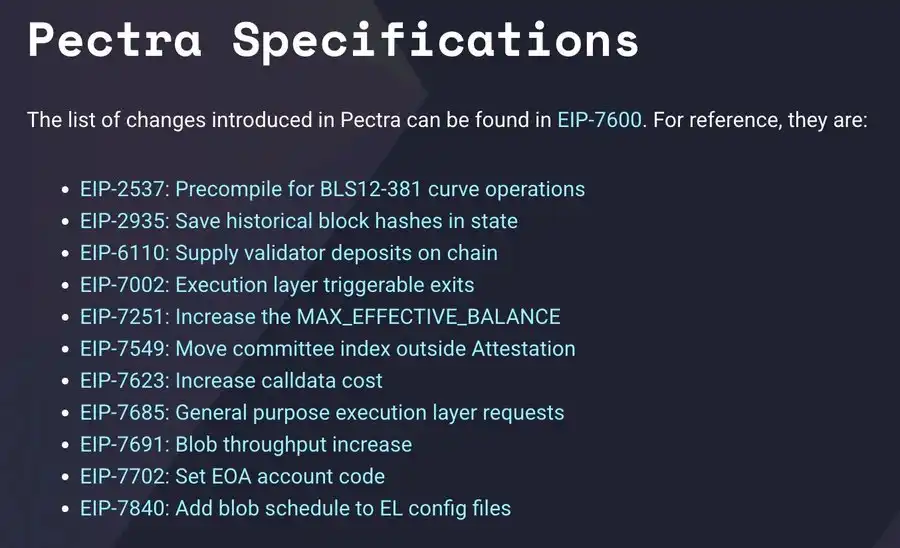
We can categorize these improvements into three key areas:
· Enhancing Ethereum Accounts
· Improving Ethereum Validator User Experience
· Expanding Block Data Capacity
Let's delve into some of the upcoming EIPs and how they enhance the Ethereum protocol and user experience.
Improving Ethereum Accounts: EIP-7702
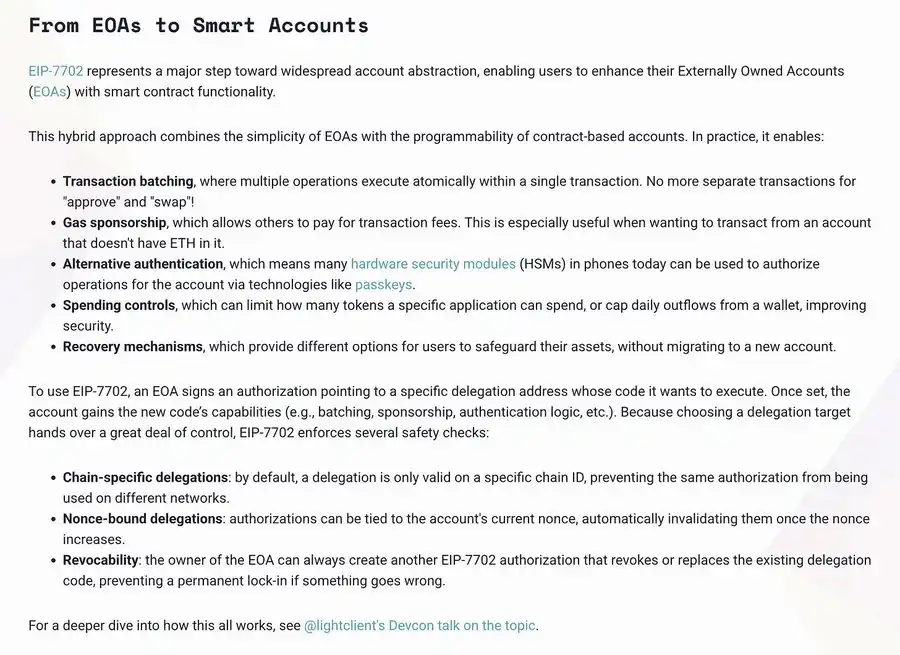
EIP-7702 advances Ethereum's protocol layer towards account abstraction. It extends Ethereum's externally owned account (EOA) functionality to include smart contract features, such as:
· Transaction Batch Execution: Performing multiple operations in a single transaction
· Gas Sponsorship: Allowing accounts with no ETH to have their transaction fees paid by others
· Enhanced identity verification and recovery mechanisms
Enhancing Ethereum Validator User Experience: EIP-7251/7002/6110
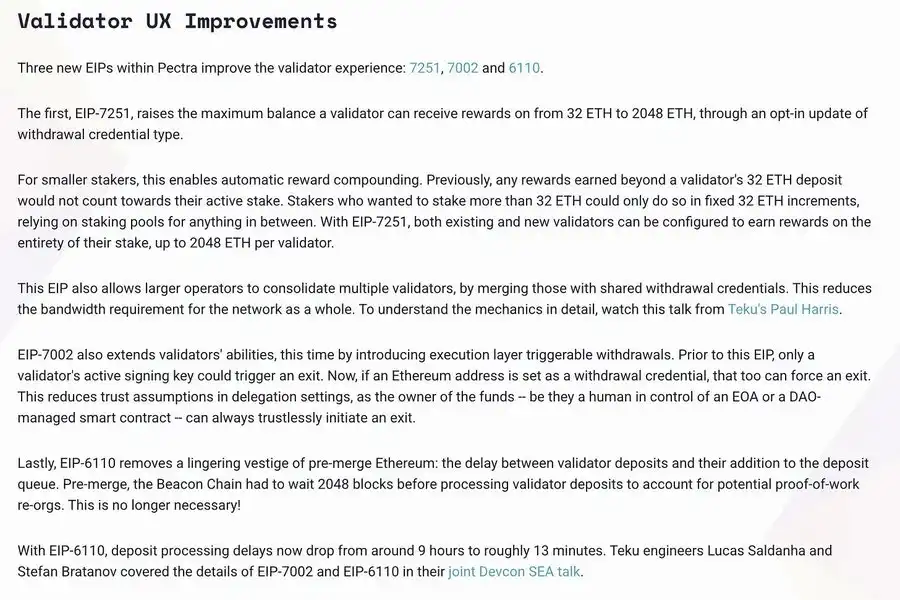
· EIP-7251: Raises the validator's maximum balance to 2048 ETH and enables them to automatically compound rewards on larger active stakes. Previously, rewards were only considered for a 32 ETH balance. Furthermore, larger validators can now merge multiple 32 ETH validators into one.
·️ EIP-7002: Reduces trust assumptions by allowing execution layer addresses to trigger withdrawals (as long as they are set as "withdrawal credentials"). Previously, only validators could trigger exits.
· EIP-6110: Eliminates the 2048-block delay for validator deposits to be queued. This time is expected to reduce from 9 hours to 13 minutes.
Extending Data Blocks: EIP-7691
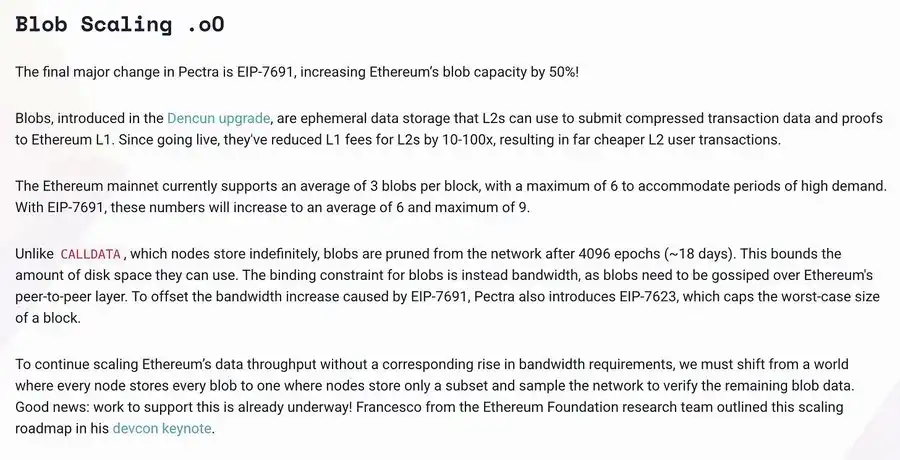
With the rising cost of data blocks, the need for extending data blocks has emerged.
Through EIP-7691, the capacity of data blocks will increase by 50%: currently, each Ethereum block can accommodate approximately 3 data blocks (up to 6 at peak demand). After implementing EIP-7691, on average, support for 6 data blocks will be available, reaching up to 9 during high demand.
The next step in further extending data blocks is to reduce the requirement to store all data blocks and move towards shards, which can still be used to validate block data.
Other EIPs in Pectra include:
· EIP-2537: Increases the security bit length of operations to over 120 bits, currently above 80 bits.
·EIP-2935: Designed for stateless clients, this EIP proposes storing historical block hashes in state as part of the block processing logic. Through contract storage implementation, the EIP allows for a smooth transition without impacting block hash logic. Rollups will be able to benefit from a longer history and directly query the storage contract.
·EIP-7549: This EIP focuses on enhancing the efficiency of the Casper client. By reducing the number of pairings required for consensus validation, particularly by removing one of the three elements from Casper client attestation messages: the committee index. By moving it out of the attestation message, achieving consensus votes can now be more efficiently aggregated into blocks, increasing the number of votes per block from 2 slots to 8.
·EIP-7623: EIP-7623 proposes an increase in the calldata cost, being one of the significant developments affecting Layer 2. This proposal aims to adjust the call data cost to address the difference between the average (100 KB) and maximum block size (7.15 MB). This will not affect regular users but only transactions mainly used for data publishing.
This increase will be introduced through a base fee that depends on the gas ratio consumed in call data operations: reduce block size to accommodate more data blocks or increase gas limits.
·EIP-7685: Introduces a framework to store requests triggered by smart contracts. This allows validators controlled by smart contracts to delegate management operations to the latter, reducing the need for intermediaries.
·EIP-2935: Designed for stateless clients, this EIP proposes storing historical block hashes in state as part of the block processing logic. Through contract storage implementation, the EIP allows for a smooth transition without impacting block hash logic. Rollups will be able to benefit from a longer history and directly query the storage contract.
The focus of this upgrade is a significant signal for Ethereum; we know these improvements have been in the works for a long time and are not in response to recent criticisms. However, focusing on simplifying network security, improving Ethereum account capabilities, and enhancing the ability to expand block data are key development directions needed to achieve Ethereum's goals.
You may also like

U.S. Oil (USOR) Price Prediction 2026–2030
Key Takeaways U.S. Oil (USOR) is a speculative Solana-based crypto project that aims to index the United States…

USOR Surges on Meme Narrative Despite No Real-World Asset Backing
Key Takeaways: USOR, a Solana-based token, has seen a notable surge driven by speculative narratives rather than verifiable…

How to Buy U.S. Oil Reserve (USOR) Cryptocurrency
Key Takeaways U.S. Oil Reserve (USOR) is a Solana-based token primarily traded on decentralized exchanges (DEXs). Claims have…

USOR vs Oil ETFs: Understanding Why the ‘Oil Reserve’ Token Doesn’t Track Crude Prices
Key Takeaways The U.S. Oil Reserve (USOR) token has become noteworthy for its claims, yet it does not…

Trend Research Reduces Ether Holdings After Major Market Turbulence
Key Takeaways: Trend Research has significantly cut down its Ether holdings, moving over 404,000 ETH to exchanges recently.…
Investors Channel $258M into Crypto Startups Despite $2 Trillion Market Sell-Off
Key Takeaways: Investors pumped approximately $258 million into crypto startups in early February, highlighting continued support for blockchain-related…
NBA Star Giannis Antetokounmpo Becomes Shareholder in Prediction Market Kalshi
Key Takeaways: Giannis Antetokounmpo, the NBA’s two-time MVP, invests in the prediction market platform Kalshi as a shareholder.…

Arizona Home Invasion Targets $66 Million in Cryptocurrency: Two Teens Charged
Key Takeaways Two teenagers from California face serious felony charges for allegedly attempting to steal $66 million in…

El Salvador’s Bukele Approval Reaches Record 91.9% Despite Limited Bitcoin Use
Key Takeaways: El Salvador President Nayib Bukele enjoys a record high approval rating of 91.9% from his populace,…

Crypto Price Prediction for February 6: XRP, Dogecoin, and Shiba Inu’s Market Movements
Key Takeaways: The crypto market experienced a notable shift with Bitcoin’s significant surge, impacting altcoins like XRP, Dogecoin,…

China Restricts Unapproved Yuan-Pegged Stablecoins to Maintain Currency Stability
Key Takeaways: China’s central bank and seven government agencies have banned the issuance of yuan-pegged stablecoins abroad without…

Solana Price Prediction: $80 SOL Looks Scary – But Smart Money Just Signaled This Might Be the Bottom
Key Takeaways Despite Solana’s descent to $80, some traders find security as smart money enters the fray, suggesting…

XRP Price Prediction: Major Ledger Upgrade Quietly Activated – Why This Could Be the Most Bullish Signal Yet
Key Takeaways: The activation of the Permissioned Domains amendment on XRPL represents a significant development in XRP’s potential…

Dogecoin Price Prediction: Death Cross Confirmed as DOGE Falls Below $0.10 – Is DOGE Reaching Zero?
Key Takeaways The death cross event signals potential bearish trends for Dogecoin as its price dips under $0.10,…

Stablecoin Inflows Have Doubled to $98B Amid Selling Pressure
Key Takeaways Stablecoin inflows to crypto exchanges have surged to $98 billion, doubling previous levels amidst heightened market…

Coinbase UK Executive Declares Tokenised Collateral a Mainstream Financial Force
Key Takeaways Tokenised collateral is transitioning from its initial experimental stages into becoming core infrastructure within financial markets.…

Best Crypto to Buy Now February 6 – XRP, Solana, Bitcoin
Key Takeaways The cryptocurrency market witnesses volatility amid a technology-sector selloff, but opportunities still exist for keen investors.…
Why Is Crypto Down Today, February 6, 2026
Key Takeaways The global cryptocurrency market has seen an 8% decline in the last 24 hours, standing at…
U.S. Oil (USOR) Price Prediction 2026–2030
Key Takeaways U.S. Oil (USOR) is a speculative Solana-based crypto project that aims to index the United States…
USOR Surges on Meme Narrative Despite No Real-World Asset Backing
Key Takeaways: USOR, a Solana-based token, has seen a notable surge driven by speculative narratives rather than verifiable…
How to Buy U.S. Oil Reserve (USOR) Cryptocurrency
Key Takeaways U.S. Oil Reserve (USOR) is a Solana-based token primarily traded on decentralized exchanges (DEXs). Claims have…
USOR vs Oil ETFs: Understanding Why the ‘Oil Reserve’ Token Doesn’t Track Crude Prices
Key Takeaways The U.S. Oil Reserve (USOR) token has become noteworthy for its claims, yet it does not…
Trend Research Reduces Ether Holdings After Major Market Turbulence
Key Takeaways: Trend Research has significantly cut down its Ether holdings, moving over 404,000 ETH to exchanges recently.…
Investors Channel $258M into Crypto Startups Despite $2 Trillion Market Sell-Off
Key Takeaways: Investors pumped approximately $258 million into crypto startups in early February, highlighting continued support for blockchain-related…


 App
App