
- Buy Crypto
- Markets
 Futures
- Spot
- Copy Trade
- Earn
- More
Deconstructing First Principles of Payments: How Can Stablecoins Unlock a Trillion-Dollar Opportunity?

Original Article Title: A First Principles Breakdown of the Crypto Payments Stack
Original Article Author: @proofofnathan
Original Article Translation: zhouzhou, BlockBeats
Editor's Note: This article explores the huge potential of stablecoins in the payment space, suggesting that stablecoins will surpass traditional payment systems due to being more efficient, faster, and cheaper. The article introduces the various layers of the crypto payments stack, from consumer wallets and payment providers to the financial integration layer, such as Banking as a Service and over-the-counter trading platforms. The application of stablecoins has not only boosted financial firms' profits but also improved user experience, driving the adoption of crypto payments. Ultimately, the core role of stablecoins in crypto payments will drive nearly all blockchains towards the payments space.
The following is the original content (slightly rephrased for better readability):
It's not just because stablecoins' supply has exceeded $230 billion, or that Circle has filed for an IPO, or that I often say, "It's already here."
It's because stablecoins are fundamentally disrupting the payments industry, and this disruption will continue at an exponential pace.
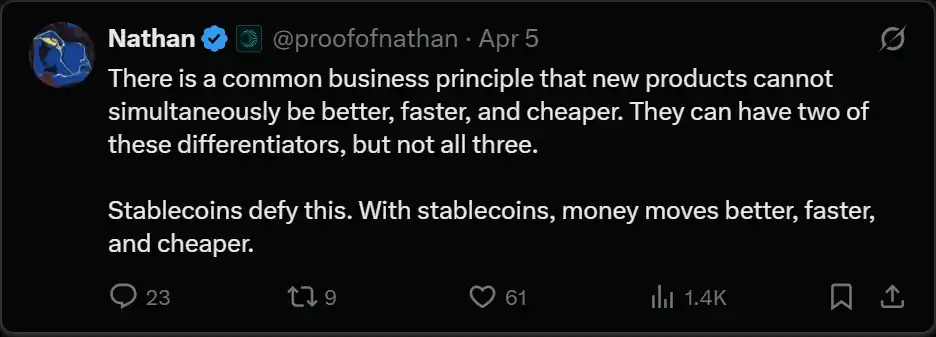
My core thesis is simple: Stablecoins will replace traditional payment methods because they are better, faster, and cheaper.
However, "payment" is a broad concept. Today's payment system is still dominated by traditional payment networks, banks, and fintech companies, each playing different roles in the payment structure of Web2.
While stablecoins offer a more efficient, highly available alternative, today's payment stack is gradually replicating the complexity of Web2 systems—this is why it is necessary for us to break it down.
Currently, hundreds of companies are building stablecoin-based payment networks or establishing complementary infrastructure alongside them.
@Dberenzon put together a fantastic chart that breaks down the on-chain payment ecosystem into nine different subdomains, and below is that chart.
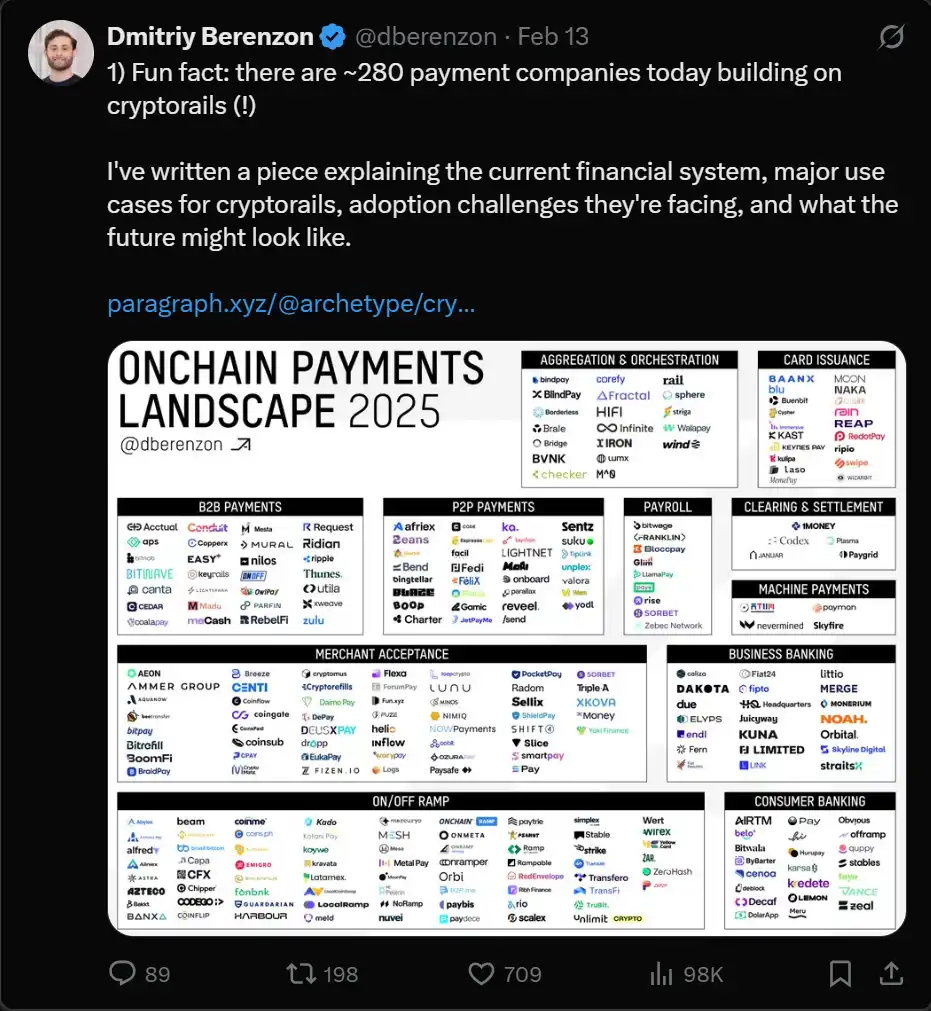
What Dmitriy provides is a deep and somewhat technical breakdown, while entities like Pantera in "The Trillion-Dollar Opportunity" take a more macro view, dividing the entire payment system into four layers.
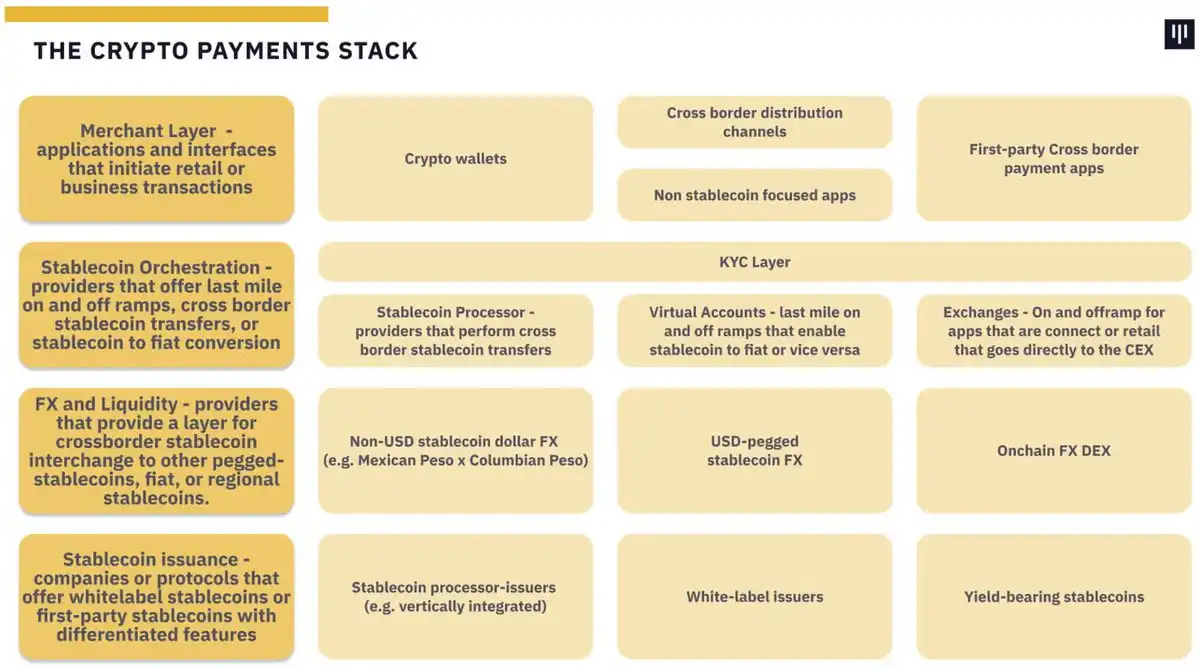
In this article, I attempt to reframe the payment stack in a crypto-native, first principles-based manner. Of course, the classification methods proposed by individuals such as Dmitriy and Pantera remain highly valuable, providing a good framework from another perspective.
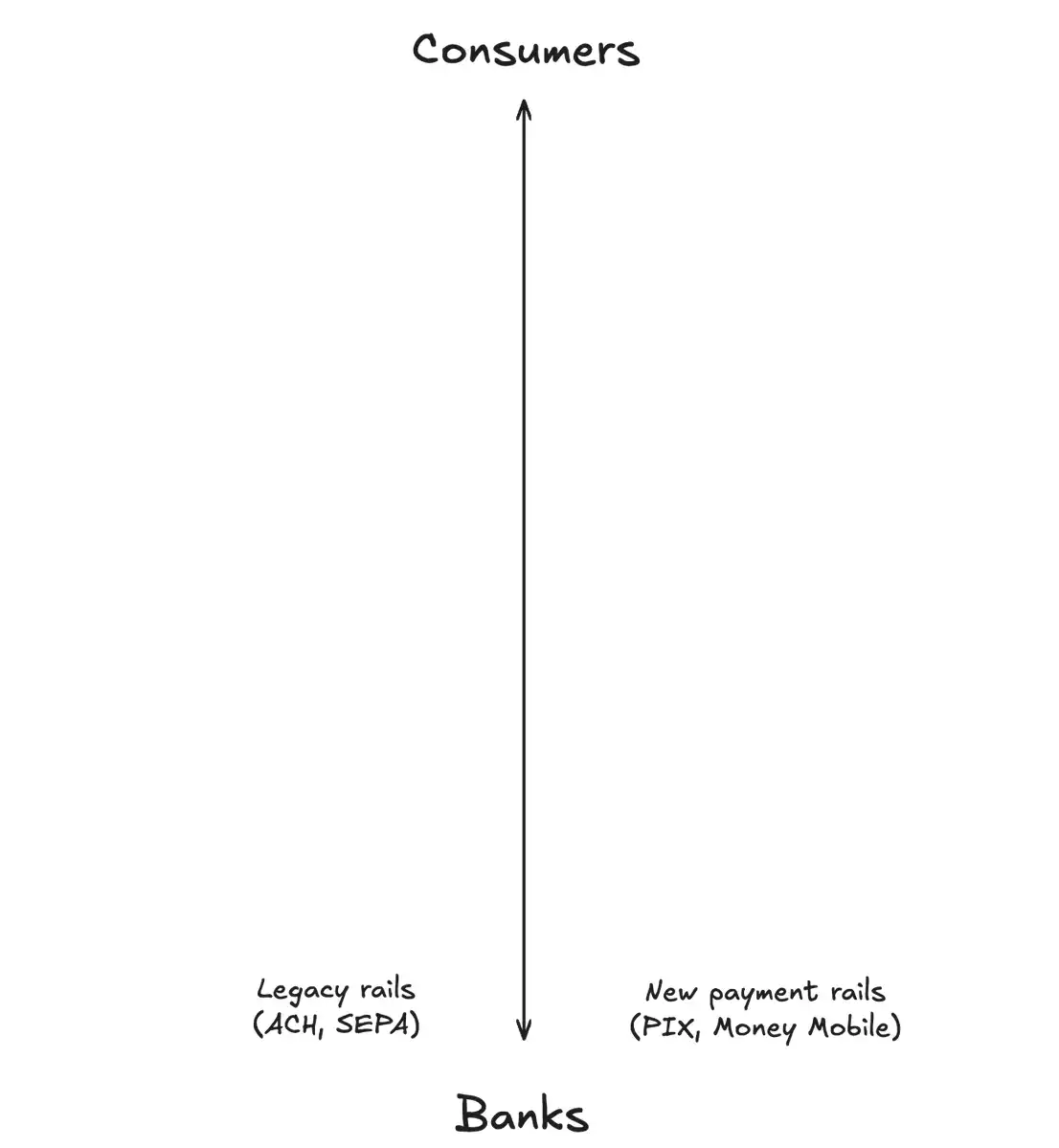
For a better understanding, I see the structure of the entire payment stack as a vertical path—where the top is one type of user and the bottom is another type of user. And I believe the ultimate achievement of the payment stack is to allow billions of users to seamlessly access the crypto system, even unknowingly.
Crypto Payments Stack
Starting from first principles, a stablecoin is a token on the blockchain that represents a fiat currency unit, with the most common being pegged to the US Dollar.
There are several types of stablecoins, including:
· Fiat-backed, such as USDT
· Crypto-backed, such as DAI
· Synthetic, such as USDe
The most dominant type is fiat-backed stablecoins. These stablecoins are backed by highly liquid assets such as US Treasuries, cash, and equivalents, held in reserves by custodians at a 1:1 ratio. Therefore, at the bottom layer of the payment stack, traditional banks and payment systems still exist.
As mentioned earlier, stablecoins are disrupting the traditional payment system because they are better, faster, and cheaper. This has not only increased the profit margins of fintech and payment companies but has also provided end-users with a better experience. Therefore, from a user perspective, consumers are at the topmost layer of the payment stack.
In conclusion, the current payment stack can be roughly understood as follows:
(An illustrative diagram will be shown here)
Now, let's look at the most core use case in the payment stack. We have seen that one of the highest user retention use cases in the crypto industry is actually the "off-ramp"—converting cryptocurrency to fiat currency.
While the concept of an "on-ramp" (converting fiat into crypto) is also common, the predominant need has always been the ability to easily spend crypto assets, especially stablecoins.
In the payment stack we are building, on/off-ramp service providers sit right in the middle.
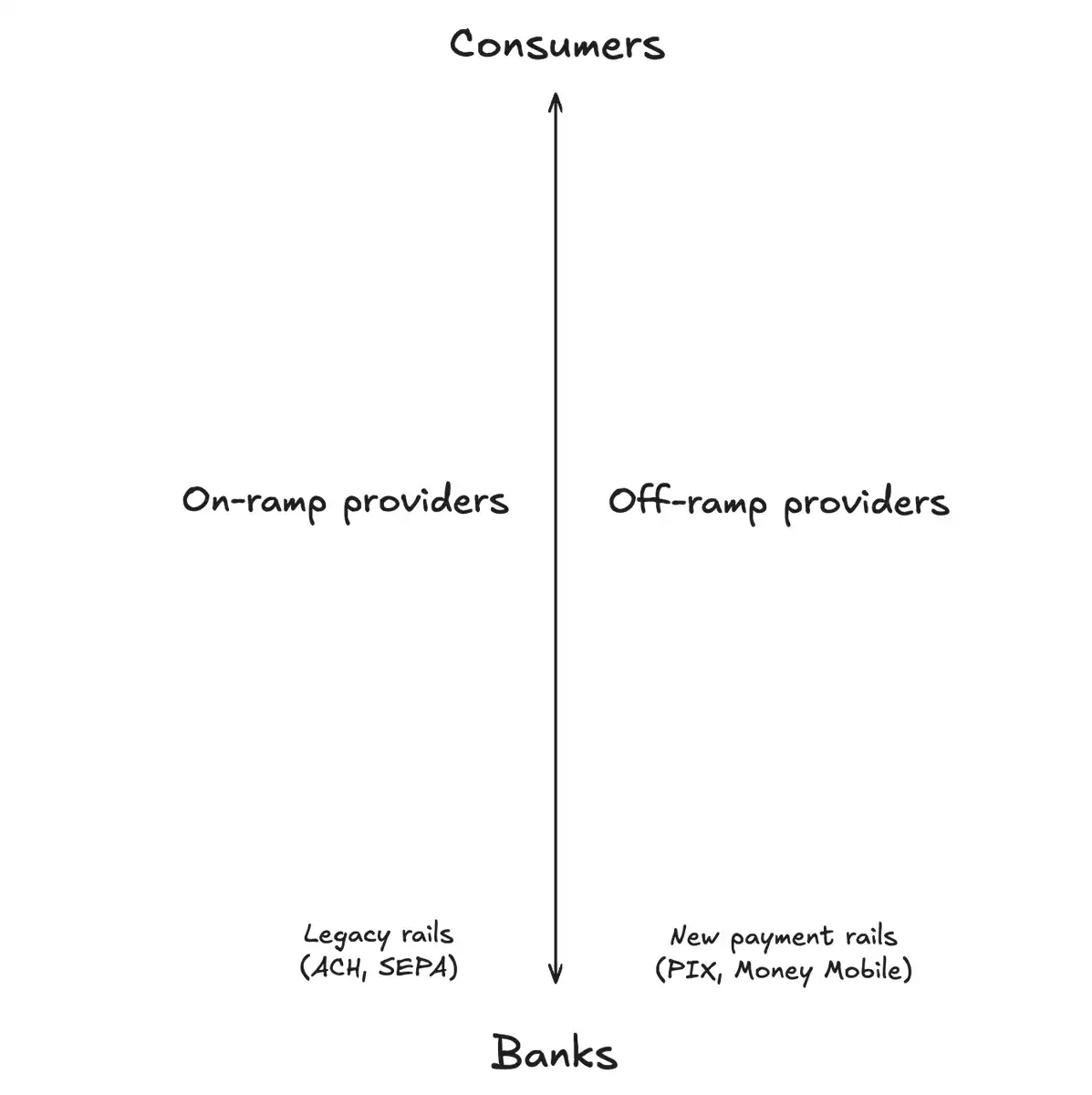
Above the on/off-ramp service providers is a section primarily focused on consumers or tools that support consumer usage, which I refer to as the **"Consumer Serving Layers".
Below them — from on/off-ramp to traditional banks — lies the part that integrates stablecoins into the traditional financial system, which I call the "Financial Integration Layers".
It is worth noting that the number of layers in the Consumer Serving Layers is much greater than in the Financial Integration Layers.
The reason is simple: building a Financial Integration Layer often requires licensing, compliance processes, and highly structured operations. Consumer Serving Layers can directly leverage the services and contractual relationships established in the lower layers to rapidly build on top of them.
Of course, there may be other modules in the Consumer Serving Layers, but here I have only selected the key parts in the entire payment stack that have clear functionality, well-defined dependencies, and a crucial role to explain.
Consumer Serving Layers
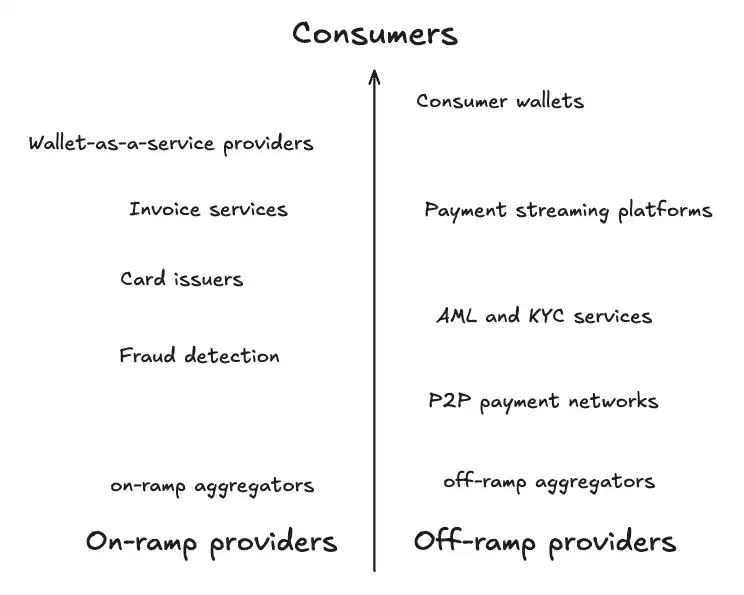
From the consumer's perspective, the first step into the crypto payment stack is a wallet.
A wallet is not just a tool for storing crypto assets; it is actually the gateway to the entire "save, spend, earn" experience.
Modern wallets usually have various functions, such as debit card payments, virtual bank accounts, peer-to-peer transfers, etc., designed to meet users' diverse scenario needs.
There are already a wide range of wallet products on the market, some targeting global users and others focusing on specific regional markets.
Building a wallet is actually very complex
It involves integrating multiple services and requires high-level security measures to prevent hacking attacks.
Therefore, many teams choose to rely on Wallet-as-a-Service (WaaS) providers. These WaaS solutions have been audited, battle-tested, and usually integrate infrastructure such as on/off-ramp services, issuer interfaces, and more.
In order to get consumer wallets truly "running," they also need to rely on various B2B stablecoin payment service providers, with key modules including:
· Invoice services: allow users to invoice their employer in crypto or fiat, with the platform receiving the payment, converting on demand, and then depositing into the user's wallet.
· Payment streaming: as companies globalize and employees are distributed worldwide, these platforms support regular stablecoin payroll, especially useful in countries where local bank access is not available.
· Card issuers: as user spending shifts from cash to electronic payments, encrypted cards become increasingly important. These issuing entities usually partner with Visa, Mastercard, enabling wallets to have the ability to "swipe card" for real-world transactions.
Compliance is also crucial, and to safeguard user funds, most platforms integrate comprehensive compliance tools at the wallet layer, including:
· KYC/AML (Know Your Customer/Anti-Money Laundering)
· On-chain fraud detection services
These compliance service providers play a significant role in the consumer service layer, both ensuring platform compliance and enhancing user trust.
Additionally, peer-to-peer payment networks are also part of the consumer layer. These networks bypass traditional payment pathways, directly connecting users and merchants for encrypted and fiat transaction exchanges.
P2P payments are widely adopted in some developing countries, but compared to the overall payment stack, they are less efficient with smaller transaction volumes, serving more as a complementary solution to traditional channels. Finally, the on/off-ramp aggregators sit at the bottom of the consumer service layer.
They consolidate multiple on/off-ramp services into a single unified API, allowing wallet developers to automatically choose solutions with faster speeds, lower fees, and better regional coverage, enhancing user experience.
Financial Integration Layers
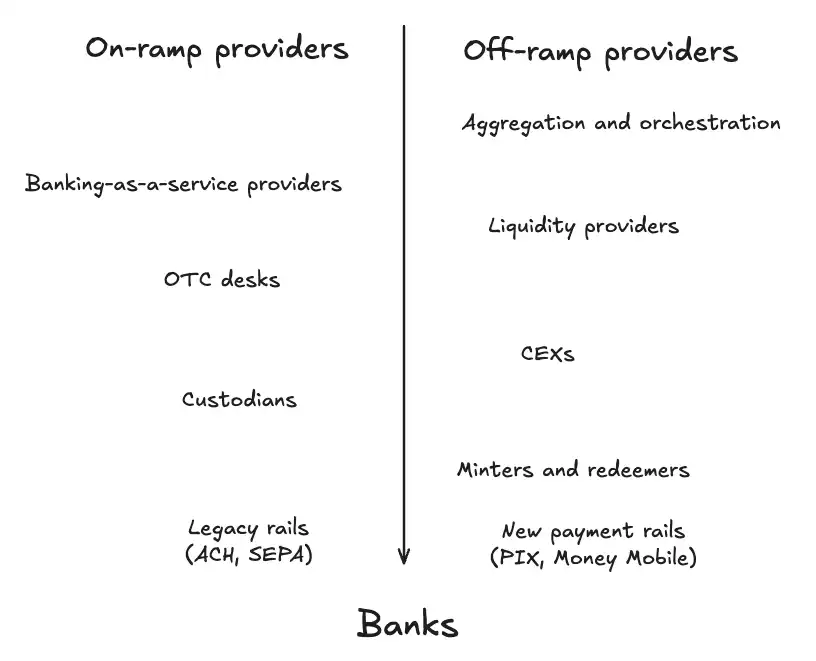
Transitioning to Financial Integration Layers brings us to the "backbone" of the entire crypto payment stack.
In the traditional payment stack, the part we are about to discuss is usually referred to as the Aggregation & Orchestration Layer. However, I believe that the reason it can "aggregate" and "orchestrate" is because it sits on top of a robust and intricate infrastructure. Therefore, this layer should be placed at the very top of the financial integration layer.
Below the Aggregation & Orchestration Layer lies the core support for the entire fund flow, with the following three layers being key foundational modules that are frequently aggregated and orchestrated:
1. Banking-as-a-Service (BaaS) Providers
These platforms offer modular financial infrastructure that allows companies to integrate services such as virtual bank accounts, card issuance, payment channels, and more.
They typically assist clients in completing compliance, back-office settlement, and other processes, enabling businesses to provide quasi-banking services in their products without holding a financial license themselves.
2. Over-the-Counter (OTC) Trading Platforms
OTC platforms specialize in handling large-volume transactions, serving as a bridge for companies that cannot directly interface with major exchanges or liquidity providers.
They can swiftly and efficiently facilitate bi-directional exchanges between stablecoins and fiat currencies, greatly simplifying the settlement process for large trades.
3. Liquidity Providers
Working closely with OTC platforms, they ensure sufficient fund availability and timely settlement for transactions globally. These institutions shield the complexity of fund movement between crypto and fiat currencies, allowing various applications to execute coin swaps, payments, and other operations through simple API calls.
Many companies are unwilling to self-custody millions of dollars' worth of stablecoins or other crypto assets. Therefore, custody service providers have become an indispensable foundational component. They offer regulated, insured, institutional-grade secure custody solutions, serving as the trust anchor for almost all crypto payment applications.
In the payment stack, Centralized Exchanges (CEXs) play a critical role, especially in the financial integration stage. They facilitate large-scale fiat-to-stablecoin settlements through liquidity provider integrations and mint/redeem services. These exchanges typically hold a portion of stablecoins and cash reserves to ensure smooth fund transfers for both parties.
At the bottom layer are the Mint & Redeem services, which form the foundation of the entire payment stack. Stablecoins exist because someone "mints" them, and others "redeem" them.
· Tether (USDT) operates its minting and redemption mechanism based on whitelisted partners who directly receive user bank transfers and exchange them for an equivalent amount of USDT.
·Circle (USDC) provides minting and redemption services through Circle Mint for companies that have completed KYB (Know Your Business) verification.
Final Summary: A Comprehensive Payment Stack Overview
The payment stack is dynamic and highly interconnected. Each layer relies on the tools, services, and providers behind it. Overall, the cryptocurrency payment stack looks like this:
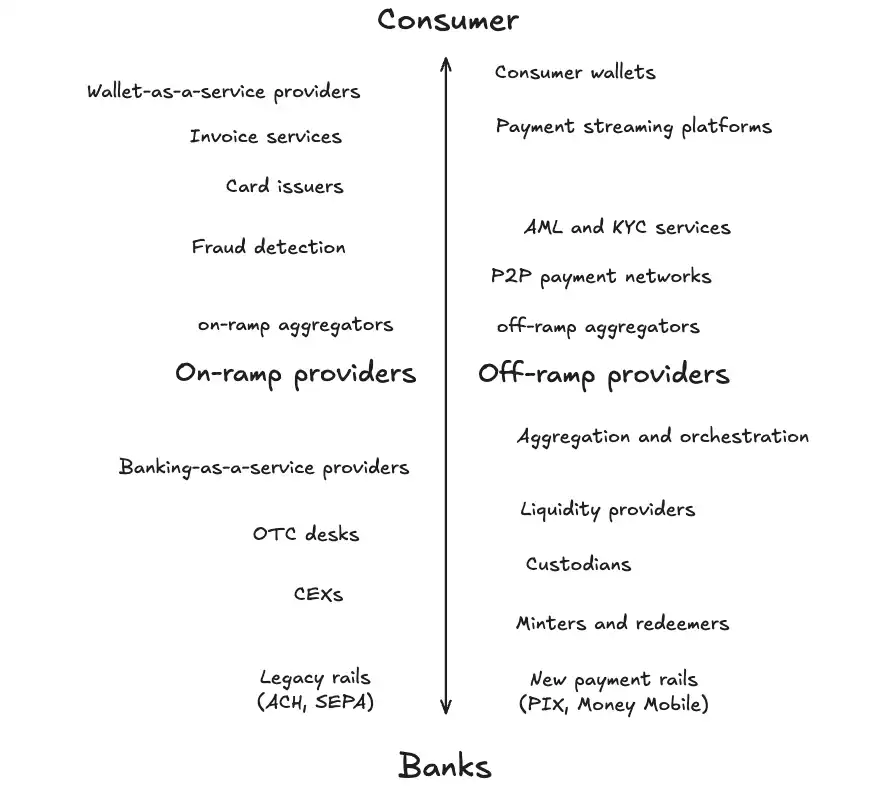
Stablecoin-driven payments represent one of the most influential and easily adoptable real-world use cases for cryptocurrencies beyond Bitcoin as a store of value. @PlasmaFDN is a blockchain designed specifically for stablecoin payments and is well-positioned in this area. However, I expect that almost all blockchains will eventually pivot towards stablecoins and the payments space.
To achieve this goal, they must rethink their payment stack—simply being EVM-compatible is no longer sufficient.
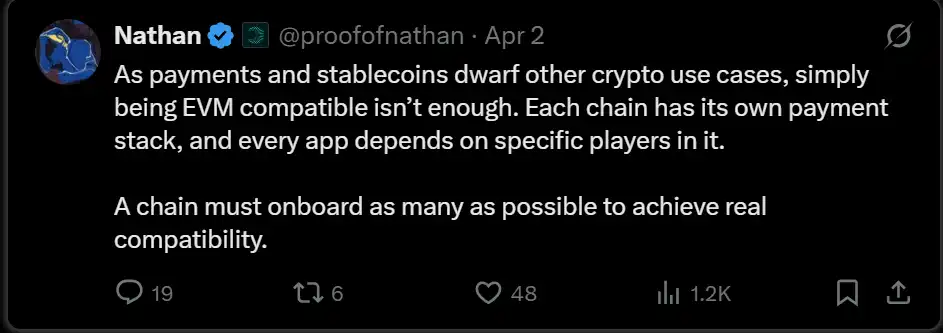
In summary, stablecoins indeed present a trillion-dollar opportunity, and those who play key roles in the payment stack will reap the greatest rewards.

Source: Original Article Link
You may also like

Kyle Samani's Exit Scam, Is There More to the Story?

February 10th Market Key Intelligence, How Much Did You Miss?

Tokenomics New Paradigm? When Backpack Starts Enabling VCs to "Deferred Gratification"

BankrCoin Achieves New Milestones as YZi Labs and ETH Investors Make Significant Moves
Key Takeaways BankrCoin (BNKR) hit a new all-time high with significant market activity. YZi Labs executed a major…

Bitcoin Tests $75K Amid Market Predictions
Key Takeaways Bitcoin shows a 47% chance to test the $75,000 mark this February, contrasting with a potential…

MrBeast Acquires Step to Enhance Financial Offerings for Youth
Key Takeaways YouTube star MrBeast has acquired the financial services platform Step through Beast Industries. The acquisition aims…

Polymarket Predicts Bitcoin Uptrend as MrBeast Ventures into Fintech
Key Takeaways Bitcoin’s Potential Surge: Polymarket denotes a fluctuating probability of Bitcoin achieving $75,000 in February, reflecting volatile…

MrBeast Enters Financial Services with Step Acquisition
Key Takeaways Binance announced an Alpha Airdrop event, highlighting the growing trend of gamified airdrops. Bitcoin prediction markets…

Analysts Predict Bitcoin May Fall to $55K as Support Levels Threaten
Key Takeaways Analysts suggest a potential drop of Bitcoin to $55K if current support levels are breached. Galaxy…

Analysts Predict Bitcoin May Drop to $55K Amid Support Challenges
Key Takeaways Experts caution that Bitcoin could fall to $55,000 if current support levels are breached. The market…

Bitcoin May Decline to $55K: Analysts Warn
Key Takeaways Analysts project Bitcoin could drop to $55,000 if key support levels fail. Technical analysts forecast that…

YZI Labs Transfers Massive ID Tokens to Binance as BNKR Hits New High
Key Takeaways BNKR, a digital currency, has achieved its highest-priced milestone of $0.295 CAD as of January 26,…
MrBeast Acquires Step, Expanding Influence in Teen Finance Market
Key Takeaways MrBeast has acquired the financial services app Step, which caters specifically to Gen Z users. Step…

Analysts Predict Bitcoin’s Critical Support Level May Trigger Decline
Key Takeaways Experts indicate a crucial moment for Bitcoin, with potential price drop to $55,000 if support fails.…
Michael Saylor Faces Bitcoin Valuation Challenges: Impact on the Crypto Market
Key Takeaways Michael Saylor’s Bitcoin investment is currently valued at $55 billion, but recent market trends have seen…

MrBeast Acquires Step FinTech App in Strategic Move
Key Takeaways MrBeast’s company, Beast Industries, has announced the acquisition of Step, a fintech app focused on Gen…

Bitcoin’s Potential Surge Sparks Debate Among Investors
Key Takeaways The probability that Bitcoin will reach $75,000 in February fluctuates as predicted by Polymarket. Bitcoin recently…
Analysts Predict Bitcoin’s Potential Plunge to $55K
Key Takeaways Analysts warn of a possible drop to $55K if Bitcoin’s current support breaks. 10X Research and…
Kyle Samani's Exit Scam, Is There More to the Story?
February 10th Market Key Intelligence, How Much Did You Miss?
Tokenomics New Paradigm? When Backpack Starts Enabling VCs to "Deferred Gratification"
BankrCoin Achieves New Milestones as YZi Labs and ETH Investors Make Significant Moves
Key Takeaways BankrCoin (BNKR) hit a new all-time high with significant market activity. YZi Labs executed a major…
Bitcoin Tests $75K Amid Market Predictions
Key Takeaways Bitcoin shows a 47% chance to test the $75,000 mark this February, contrasting with a potential…
MrBeast Acquires Step to Enhance Financial Offerings for Youth
Key Takeaways YouTube star MrBeast has acquired the financial services platform Step through Beast Industries. The acquisition aims…


 App
App