
- Buy Crypto
- Markets
 Futures
- Spot
- Copy Trade
 Earn
Earn- More
From Governance to Staking: A Comprehensive Analysis of the Multi-faceted Use Cases and Future Growth of the ZRO Token

Original Title: LayerZero Part 3 — Zero token: Utilities and Future Prospect
Original Source: Animoca Brands Research
Original Translation: Scof, Chaincatcher
Overview
· The $ZRO token was launched in June 2024, with planned use cases including protocol governance, transaction fee payment, and staking for DVN security. These three functions have a significant impact on the value of $ZRO.
· We expect that over the next three years, the circulating supply of $ZRO will increase rapidly, accompanied by growth in on-chain usage and its adoption as a common currency for cross-chain transactions.
· We have proposed a valuation framework for $ZRO, utilizing the Market Cap to Transaction Volume ratio (MCTx), combined with projected transaction volume scenarios. This framework aims to provide readers with a perspective on the relationship between protocol growth and token value.
Introduction
In Part 1 and Part 2 of the LayerZero series, we introduced the LayerZero protocol's mechanics, business model, and the dynamics of the entire cross-chain space. In this third part of the series, we will focus on the protocol's token, $ZRO.
Token Utility
The LayerZero $ZRO token went live on June 20, 2024, and was listed on major exchanges such as Binance, OKX, Bybit, and Gate.io. Initially, $ZRO was distributed through airdrops to reward early contributors and community members. Over the past five months, the project team has steadily rolled out various token utilities, further expanding its role in the LayerZero ecosystem.
The applications of the $ZRO token can be summarized into three typical categories, which are more common in infrastructure tokens, and we will interpret them one by one:
1. Protocol Governance: $ZRO holders can vote to determine key protocol decisions, influencing the development direction and evolution of LayerZero.
2. Protocol Transaction Fees: $ZRO can be used to pay protocol fees, in addition to on-chain native tokens, and can also be used for transaction fee payments within the LayerZero network.
3. DVN Security Staking: $ZRO is the accepted staking asset used to help secure the LayerZero Lab's Distributed Validation Network (DVN) and support the network's security and stability.
Protocol Governance
The first announced use case of $ZRO is to govern the potential protocol fee switch, as mentioned in the initial $ZRO token introduction.
· The LayerZero protocol may charge a fee equal to the total cost of cross-chain message validation and execution. If the DVN and executor charge a $0.01 fee for transactions between Arbitrum and Optimism, LayerZero may also charge a $0.01 fee.
· There will be an "immutable voting contract" with a biannual on-chain referendum allowing $ZRO holders to vote on whether to activate or deactivate the protocol fee switch.
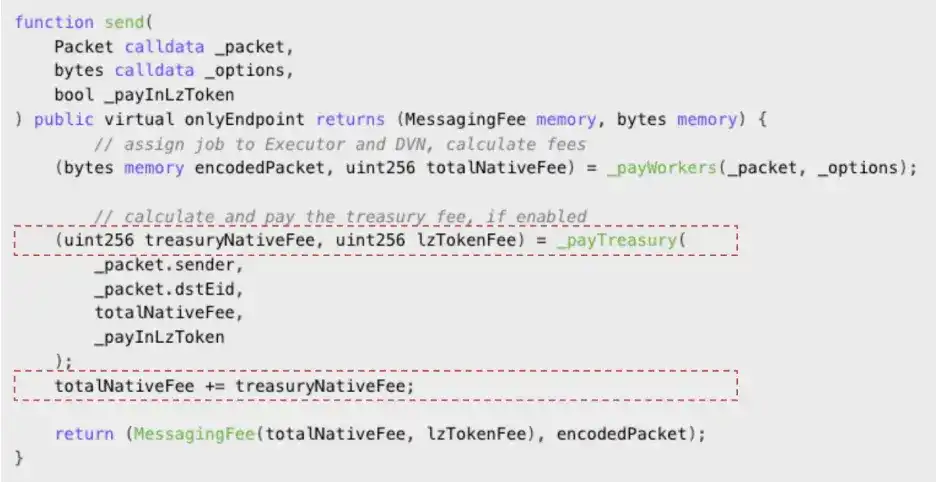
LayerZero currently charges a fee for each transaction to cover the costs incurred by the DVN and executor in performing their roles. If the protocol fee is implemented, an additional layer of fees will be added on top of these operational costs. According to the project team, this additional fee could be as high as 100% of the existing transaction fee. Although the biannual voting contract has not yet been announced, support for this protocol fee has been built into LayerZero's V2 codebase, with the functionality named "_payTreasury" already capable of collecting this additional fee.
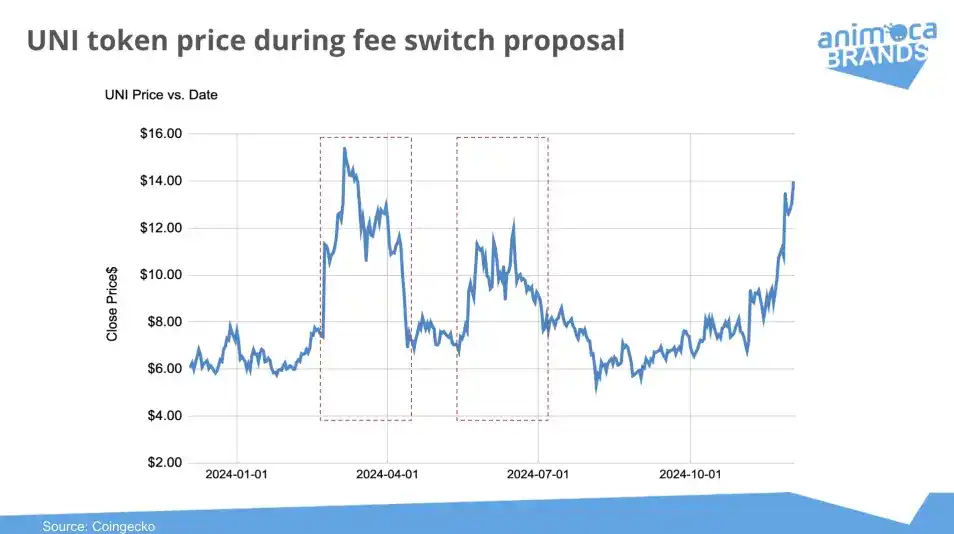
UNI Token Price During Fee Switch Proposal
Looking ahead to the potential fee switch governance mechanism for the $ZRO token, a similar case can be found in Uniswap's $UNI token, which also features a similar protocol fee governance function.
When $UNI was launched in 2020, it included an option for the community to vote on whether to activate the fee switch. If this switch is activated, a portion of the decentralized exchange (DEX) trading fees will be redirected to the protocol, potentially benefiting $UNI holders. Since mid-2022, multiple fee switch proposals have been put forward, each announcement causing significant price spikes in $UNI. For example, with the release of a new proposal in March 2024, the price of $UNI surged by 65%, only to retreat after the voting results were announced. A similar price fluctuation pattern was seen with the May 2024 proposal.
However, all fee switch proposals to date have been voted down or withdrawn. Despite the potential alignment of introducing fees with investor interests by creating value for the protocol and $UNI holders, it faces two main opposing voices:
1. Competitiveness Impact: Increasing protocol fees may reduce Uniswap's competitiveness as it effectively taxes transactions, which could increase costs for liquidity providers or users.
2. Regulatory Risk: Distributing generated value to token holders or stakers may attract regulatory scrutiny, especially if this practice is seen as income distribution, which could touch on securities law issues.
It is currently unclear whether $ZRO will face the same voting challenge as Uniswap's $UNI, with the key lying in the specific design of the fee voting mechanism, which has not yet been fully disclosed. Given the rapid growth and intense competition in the cross-chain protocol space, LayerZero's current primary task may be to focus on expanding market share rather than pursuing short-term value accrual for $ZRO. Finding a balance between enhancing protocol value and maintaining competitiveness in transaction costs will be key for LayerZero to promote sustainable long-term growth, while also considering investor interests.
In a recent speech, LayerZero's CEO Bryan Pellegrino announced during the Q&A session that the first governance vote is scheduled to take place on December 19, 2024, coinciding with the six-month anniversary of the token's release. The speech video was released on November 19, 2024, and since then, the price of $ZRO has been on the rise.
Protocol Transaction Fees
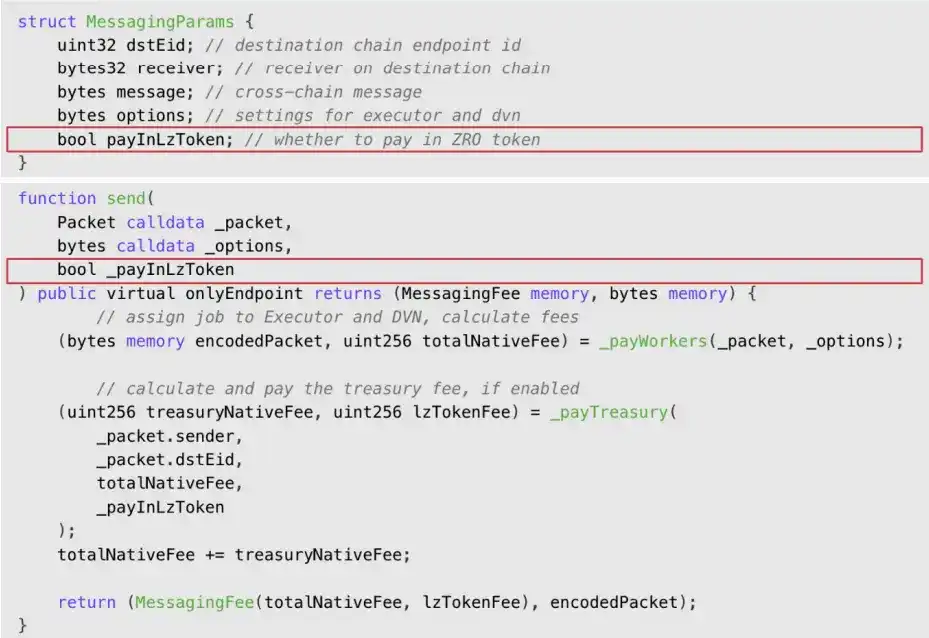
In addition to the announced use cases, the protocol's codebase also supports using $ZRO as an alternative currency for transaction fees. When the "payInLzToken" flag is set to TRUE, protocol transaction fees will be paid in $ZRO instead of the native token of the chain. However, the native token is still the protocol's default payment method, and we have not yet seen projects actively switch to using $ZRO to pay fees.
Accepting $ZRO as protocol fees can significantly expand the token's utility and demand. Projects integrating will need to maintain a $ZRO reserve to cover ongoing protocol usage, creating continuous demand. As the LayerZero ecosystem grows, the demand for $ZRO will correspondingly increase, requiring a larger reserve to support the growing cross-chain operations.
This cross-chain demand for $ZRO extension will also have a compounding effect: as the LayerZero network expands its connections, $ZRO will span multiple ecosystems, becoming one of the most widely used tokens in the cross-chain space. Its broad availability could make $ZRO the preferred currency for cross-chain transactions, similar to ETH's role in the EVM ecosystem.
Despite its many benefits, transitioning the default native token to $ZRO still requires thorough preparation and incentive measures, such as:
1. $ZRO Deployment: Currently, $ZRO is deployed on 8 chains, while LayerZero covers 90 networks. Expanding $ZRO's application to more chains is crucial for its widespread adoption as the default fee token.
2. Project Incentives: Currently, on-chain native tokens have a wider range of applications than $ZRO, so sufficient incentive measures need to be provided to encourage projects to choose $ZRO. Possible incentive measures include fee discounts when using $ZRO or establishing a single $ZRO reserve covering fees on all LayerZero-supported chains, making it more appealing to developers.
3. Implementation Operations: For the 50,000 contracts already deployed, the _payInLzToken flag needs to be manually enabled for each contract. To simplify this process, a unified switch at the protocol level may be necessary, or a one-time incentive may be provided to encourage project teams to adjust their contract settings.
Given the importance of $ZRO as the protocol fee currency, closely monitoring LayerZero's plans and developments in promoting $ZRO as the fee token is crucial.
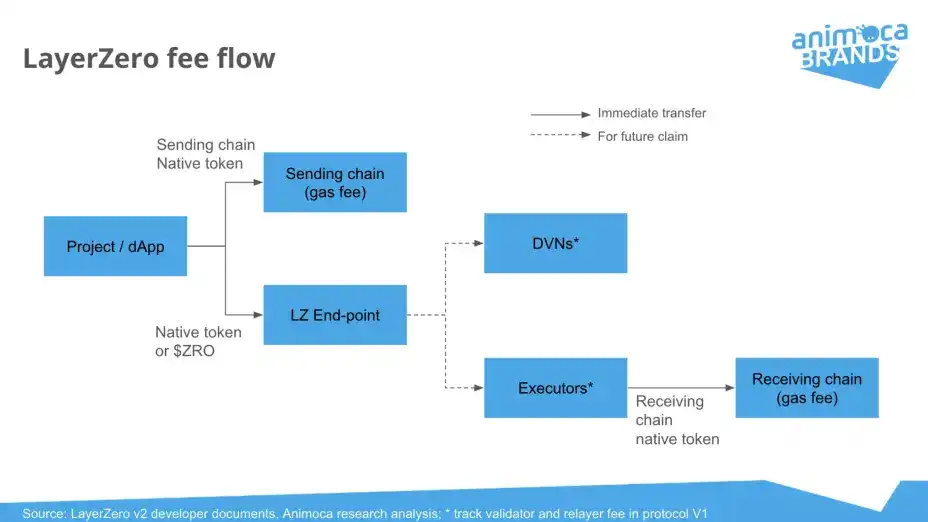
LayerZero Fee Flow
Staking: Decentralized Validation Network (DVN) Cryptoeconomics Framework
In October 2024, LayerZero and EigenLayer announced a partnership to develop an open-source cryptoeconomics framework for Decentralized Validation Networks (DVNs). This framework aims to enhance the security of DVNs by introducing economic incentives, allowing users and decentralized applications (dApps) to consider factors beyond just technical stability when choosing a DVN.
The framework introduces an arbitration process that runs on a specified chain (e.g., Ethereum), allowing DVN to stake assets and provide validation when the validity of cross-chain messages is in question. The specific process is as follows:
· Staking: Stakers lock assets into DVN through EigenLayer's AVS. If DVN is found to behave maliciously or provide incorrect validation, these assets may be slashed.
· Validation: If a user or dApp disputes the validity of a message, the framework triggers a round-trip message asking other DVNs to validate the accuracy of the original message.
· Veto: In case of a mismatch, the veto contract will escalate the decision, prompting token holders to vote on whether to slash the DVN's stake.
· Slashing: If the vote confirms malicious or erroneous behavior, the staked assets will be slashed.
As an open-source framework, any DVN can adopt it and freely choose staking assets. LayerZero Labs' DVN will be the first to implement this framework on Ethereum, accepting $ZRO, $EIGEN, and $ETH as staking assets. As LayerZero Labs' DVN still handles most of the protocol's validation work, the additional staking pool could become a significant driver for $ZRO staking.
Specific incentives for $ZRO holders to participate in this staking pool have not been disclosed yet, making it difficult to predict the total amount of $ZRO that might be staked. Overall, staking helps regulate the token supply in circulation, potentially functioning similar to a central bank in balancing demand and supply.
$ZRO Tokenomics
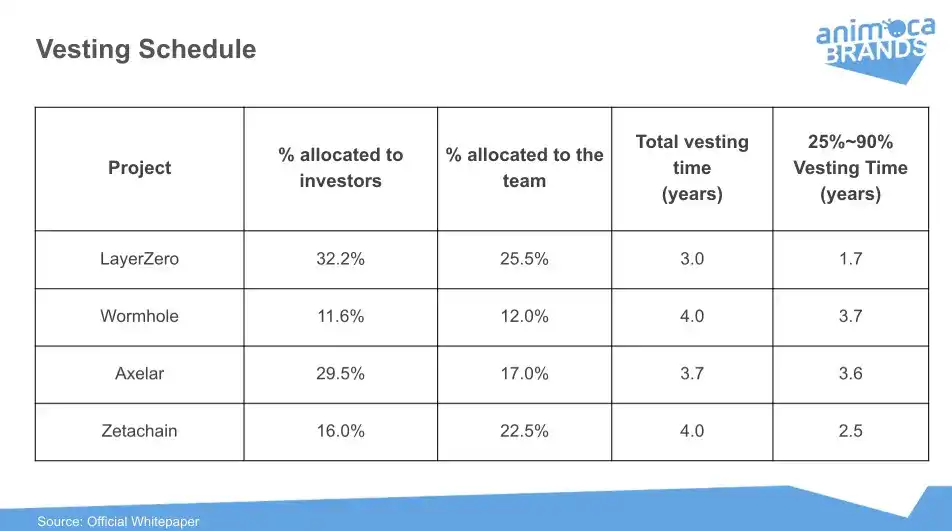
The distribution and unlocking schedule of $ZRO were clearly outlined in the initial announcement. A total of 1 billion $ZRO tokens will be allocated across four categories:
· 38.3% to the Community: including operational funds for the LayerZero Foundation.
· 32.2% to Strategic Partners: such as investors and advisors.
· 25.5% to Core Contributors: allocated to current and future team members.
· 4% for Token Buyback by LayerZero Labs: to be used for future community activities.
At the Token Generation Event (TGE), 25% of $ZRO tokens have already been unlocked, all from the Community category. The remaining locked tokens will unlock linearly in the second and third years, with all 1 billion tokens fully unlocked by the end of the third year.
In the unlocked 25% of the tokens:
· 8.5% is allocated to reward early contributors and has been distributed to the community through an airdrop.
· 5% is allocated to the LayerZero Foundation's treasury, including liquidity pools.
· 11.5% is reserved for future activities.
Token Unlock Schedule
By the second half of 2024, the circulating token supply will stabilize at around 11% of the total supply. This stability is expected as there are no further unlocks in the first year. Starting from the second year, the supply will increase, with the remaining 75% of the tokens fully unlocked by the end of the third year. With the acceleration of the unlock schedule, a significant portion of the tokens has been allocated to strategic partners (32.2%) and the team (25.5%), which may quickly enter circulation post-unlock.
The rapid unlock for investors and the team may put time pressure on the LayerZero team, requiring them to quickly enhance the project's overall value. We anticipate that approximately 65% of the $ZRO tokens will be in circulation by the end of the three-year unlock period (based on Chainlink). This means that the circulating supply will increase fivefold compared to the current level. Such rapid supply growth will necessitate a corresponding increase in the project's market cap to maintain price stability.
$ZRO Value Framework
To help readers establish a clear mental model for evaluating the value of $ZRO, we propose a structured framework based on cross-chain trends and LayerZero's strategic positioning in this field. This framework aims to assist users in assessing the $ZRO token by considering various factors, although specific parameters will vary based on individual views of the industry and project growth.
Our goal is not to provide a definitive set of parameters but to offer a flexible framework that readers can adjust based on their analysis. It is important to note that this framework is not exhaustive or conclusive.
Method
One way to evaluate the $ZRO token is by applying the Market Cap to Transaction Volume ratio (MCTx), combined with LayerZero's projected three-year transaction volume scenario. The reason for selecting the MCTx ratio is that transaction volume is a key driver of protocol success, and transaction volume data is widely available in major projects, allowing us to evaluate a reasonable range. The three-year timeframe aligns with the unlock period of the $ZRO token, and the cross-chain space is likely to maintain high growth momentum. Additionally, we will cross-validate by comparing with Layer 1 protocols like Ethereum and Solana.
Market Cap to Transaction Volume Ratio (MCTx)
First, we establish a reference Market Cap to Transaction Volume Ratio (MCTx) using Wormhole, Axelar, and ZetaChain as benchmarks compared to LayerZero. These four protocols all focus on cross-chain messaging and have released tokens in the past 12 months. We use data from the third quarter of 2024 as the observation window, tracking their average daily transaction volume and market cap, as this period is far from any short-term transaction volume spikes.
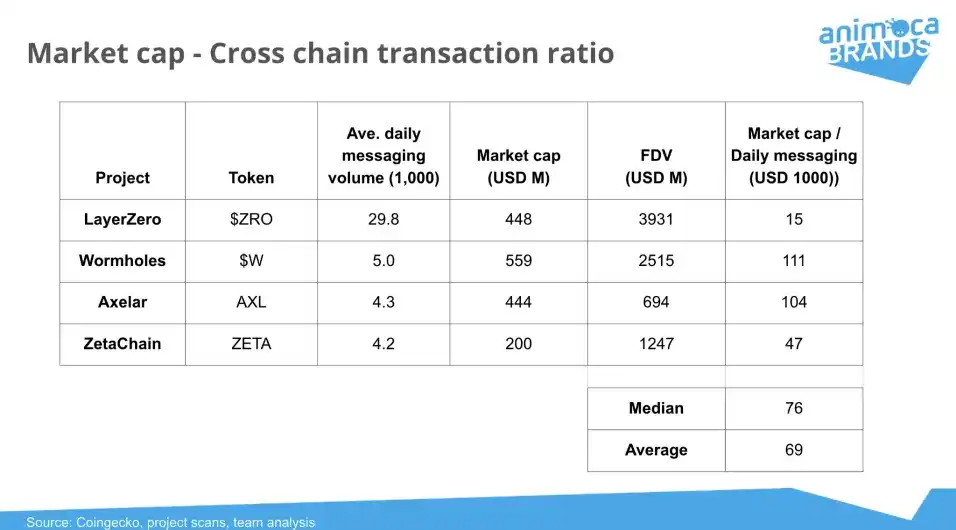
Market Cap to Cross-Chain Transaction Volume Ratio
The MCTx ratio for comparable projects ranges between 50 and 100, while LayerZero's current ratio is lower. One reason could be that the circulating supply of $ZRO is relatively low, which is related to its later TGE issuance and first-year unlock schedule. Another factor may be that compared to other projects, the utility of $ZRO is relatively limited. For example, AXL and ZETA tokens not only facilitate cross-chain transactions but also support the operation of their respective blockchains.
We expect that as the industry evolves, the MCTx ratio will converge among leading projects, and transaction volume will become the primary driver of protocol value. In the following example, we use a MCTx ratio of 50 for illustration.
The next step is to create a scenario for LayerZero's future transaction volume. In the second part of our coverage on LayerZero, we estimate that the current cross-chain transaction/message volume is approximately 3.5 million per month (roughly 120,000 per day), with LayerZero capturing 25% to 30% market share. We also anticipate that due to on-chain liquidity scaling and an increase in the number of chains, the industry's annual transaction volume growth will reach around 100%.
Based on these parameters, readers can develop assumptions for LayerZero's future 3-year transaction volume scenarios based on different industry growth rates and LayerZero's market share composition. In this process, readers may need to estimate daily transaction volumes under different scenarios and apply the MCTx ratio to derive an estimated range of ZRO's market cap at specific time points.
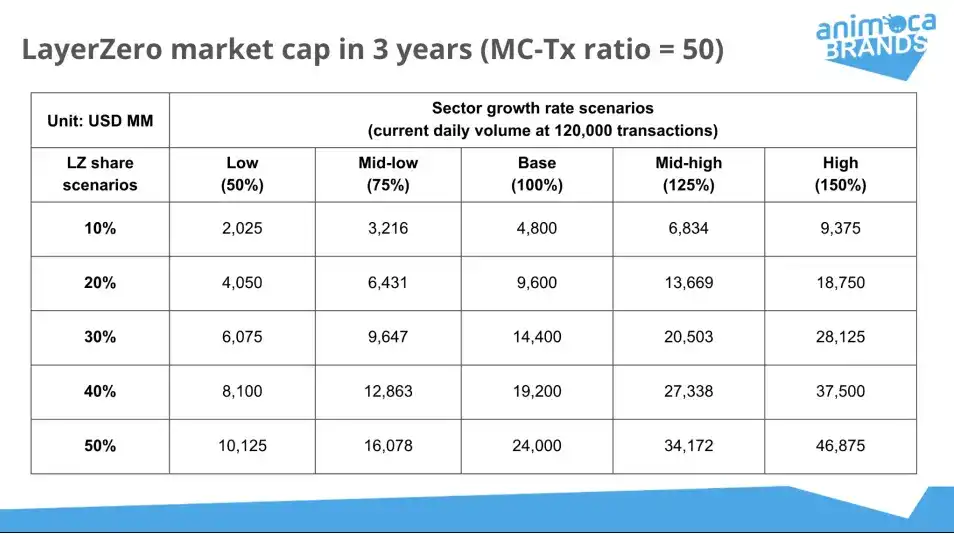
LayerZero Future Three-Year Transaction Volume
By applying a 50 MCTx ratio, we can convert each daily transaction volume scenario into a market cap estimate. This resulted in a market cap prediction for the $ZRO token over the next three years of $20 billion in the most conservative scenario and $470 billion in the most optimistic scenario.
LayerZero Market Cap Estimate Over the Next Three Years
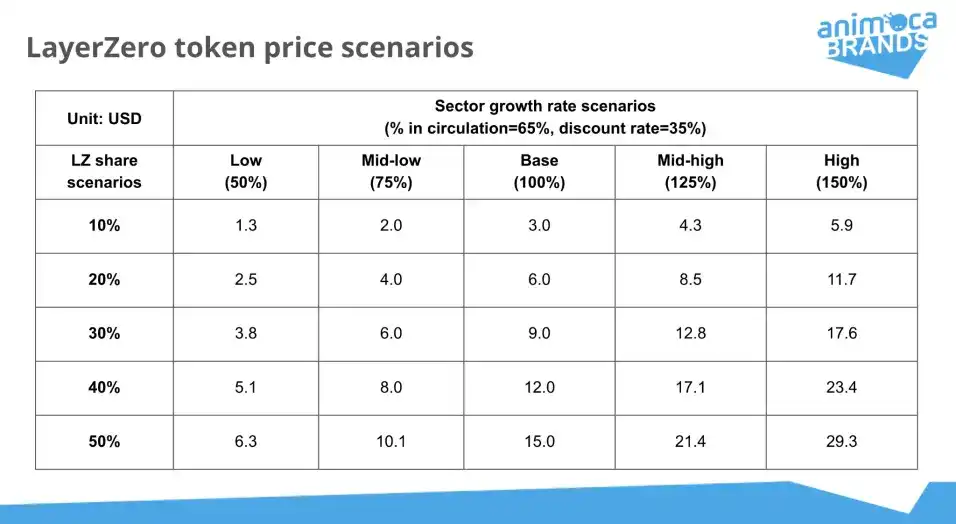
To derive the present value of $ZRO, we introduced additional assumptions: a circulating supply of 65% for the $ZRO token and applied a 35% discount rate to adjust for future value. Based on these parameters, we calculated the current estimated value of the $ZRO token for each scenario.
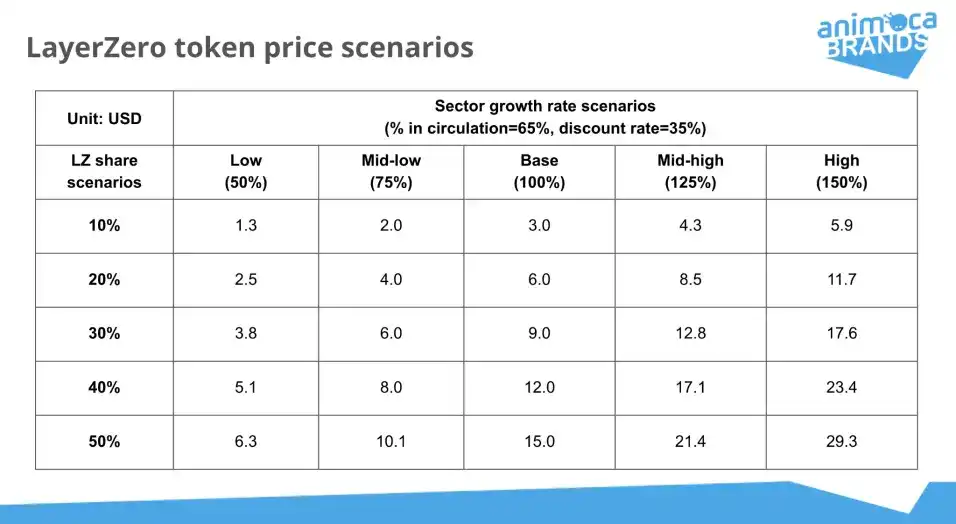
Potential $ZRO Token Prices on LayerZero
Keep in mind that the method described above is just one of many possible ways to evaluate the value of $ZRO. The estimated value of $ZRO is highly sensitive to multiple factors, including the cross-chain industry's future growth rate and LayerZero's market share within it. The future trajectory of this industry will largely depend on the broader cryptocurrency market environment, which itself is highly volatile. Additionally, LayerZero's market share will be influenced by its ability to provide robust, user-retaining technology and effectively capitalize on emerging business opportunities.
Triangle Measurement of MCTx Ratio
As an additional reference, the MCTx ratio used in the previous section can undergo a triangle measurement. One approach is to convert the MCTx ratio into an MCTx fee ratio and compare it with leading infrastructure projects like Ethereum and Solana. In the first part of our LayerZero analysis, we estimated LayerZero's average transaction fee to be around $0.70. Based on this data, a scenario with an MCTx ratio of 50 (i.e., $1,000 daily) results in an MCTx fee ratio of 196.
This makes LayerZero's three-year MCTx fee ratio close to the current ratios of Ethereum and Solana, which are 250 and 226, respectively. This similarity also implies that $ZRO needs to become a core part of the LayerZero ecosystem, just like $ETH and $SOL are in their respective networks, in order to support the rationale for its multiples. Whether $ZRO can achieve this remains a contentious topic, with arguments on both sides.
Main points of support may include:
· Cross-chain protocols and Layer 1 projects generate protocol revenue by collecting transaction fees and paying fees to validator nodes.
· With the recent introduction of the EigenLayer partnership, the $ZRO token may play a significant role in LayerZero's DVN operation, similar to how $ETH and $SOL are utilized in their respective networks.
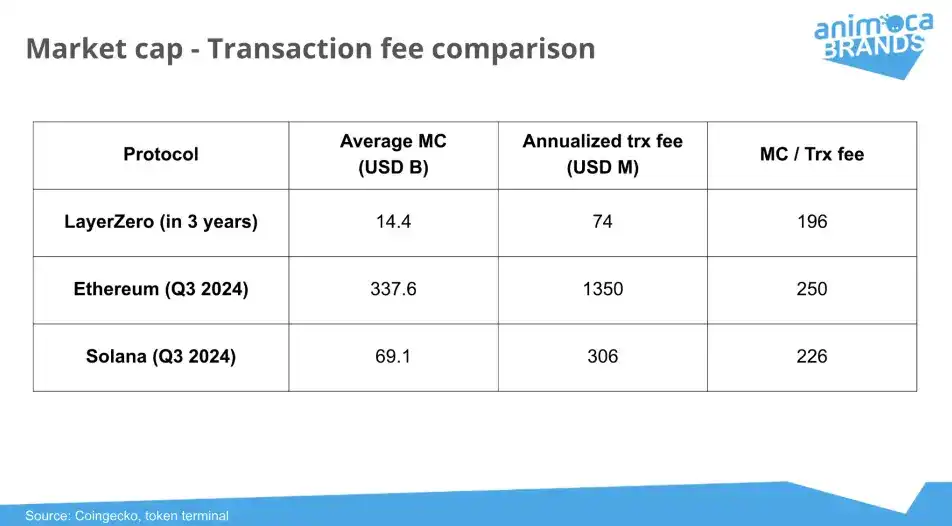
Market Cap vs. Transaction Fees Comparison
Counterarguments:
Possible counterpoints may include:
· $ZRO is not yet the default transaction fee payment token: Currently, $ZRO is not the default fee token for all transactions, thus its widespread adoption remains limited.
· Fee switching introduces uncertainty: The fee-switching feature introduces uncertainty for users and developers, potentially impacting their decision-making, especially if fee structures change frequently.
· $ZRO is currently not used as a "transaction currency": $ZRO currently serves only as a protocol fee payment tool and has not evolved into a widely used transaction currency. Therefore, its primary token function for cross-chain transactions has not yet been fully realized.
· $ZRO is not the sole token available for DVN staking: While $ZRO plays a crucial role in the LayerZero ecosystem, it is not the only token available for DVN staking, limiting its exclusivity in certain contexts.
Varied perspectives on these factors may influence market participants' assessment of the MCTx fee ratio and MCTx transaction volume ratio, thus leading to adjustments based on different assumptions regarding $ZRO's future role.
Other Risks to Consider
Resilience of LayerZero V2 Architecture
The LayerZero V2 was launched in December 2023 and has not reported any security vulnerabilities to date. The protocol's confidence in its design is reflected in its $15 million bug bounty, which is among the highest in the industry.
One of the core principles of the LayerZero security model is that there is no collusion between the DVN (Decentralized Validation Network) and Executors. So far, this design has worked well, partly because Executors are fully operated by LayerZero, while the DVN remains decentralized. However, as LayerZero begins to allow external parties to build Executors, the possibility of collusion has increased.
Furthermore, as more projects adopt LayerZero as their primary cross-chain asset transfer and governance infrastructure, malicious actors will have an increasing incentive to attack the network. A security breach could significantly damage LayerZero's growth trajectory, slow down future development, and have a negative impact on the value of the $ZRO token.
Deployment of $ZRO Utility
By the end of 2024, the full utility of $ZRO has not yet been realized. The high expectations for $ZRO need to be supported through actual usage, such as:
· Semi-annual Fee Switch Voting: Introducing a fee switch voting mechanism to enhance the value accrual expectation for token holders.
· Defaulting $ZRO as Fee Currency: Increasing the amount of $ZRO held in decentralized applications (dApps) and improving fund velocity.
· Adoption of $ZRO as a General Transaction Currency: Expanding the use cases of $ZRO to make it not only used internally in LayerZero but also accepted widely as a cross-chain token.
If these utility goals are achieved, it will significantly elevate the role of the $ZRO token within the LayerZero network. However, as technology advances, LayerZero will face not only development challenges but also strategic efforts in user engagement, partnerships, and ecosystem incentives to comprehensively integrate these utilities.
Summary
The $ZRO token is planned to become a core part of the LayerZero ecosystem, providing key utility for governance, protocol fees, and DVN staking. Furthermore, as the protocol evolves, the role of $ZRO is expected to further expand, potentially becoming a widely used cross-chain transaction currency. We anticipate that in the next three years, both LayerZero and $ZRO utility will go through a rapid growth phase.
While $ZRO currently lacks direct utility, we have outlined a potential valuation model that helps readers provide context for future protocol development and assess the role of $ZRO in the protocol's future through predictions of the MCTx ratio and future protocol transaction volume.
You may also like

Token Cannot Compound, Where Is the Real Investment Opportunity?

February 6th Market Key Intelligence, How Much Did You Miss?

China's Central Bank and Eight Other Departments' Latest Regulatory Focus: Key Attention to RWA Tokenized Asset Risk
Foreword: Today, the People's Bank of China's website published the "Notice of the People's Bank of China, National Development and Reform Commission, Ministry of Industry and Information Technology, Ministry of Public Security, State Administration for Market Regulation, China Banking and Insurance Regulatory Commission, China Securities Regulatory Commission, State Administration of Foreign Exchange on Further Preventing and Dealing with Risks Related to Virtual Currency and Others (Yinfa [2026] No. 42)", the latest regulatory requirements from the eight departments including the central bank, which are basically consistent with the regulatory requirements of recent years. The main focus of the regulation is on speculative activities such as virtual currency trading, exchanges, ICOs, overseas platform services, and this time, regulatory oversight of RWA has been added, explicitly prohibiting RWA tokenization, stablecoins (especially those pegged to the RMB). The following is the full text:
To the people's governments of all provinces, autonomous regions, and municipalities directly under the Central Government, the Xinjiang Production and Construction Corps:
Recently, there have been speculative activities related to virtual currency and Real-World Assets (RWA) tokenization, disrupting the economic and financial order and jeopardizing the property security of the people. In order to further prevent and address the risks related to virtual currency and Real-World Assets tokenization, effectively safeguard national security and social stability, in accordance with the "Law of the People's Republic of China on the People's Bank of China," "Law of the People's Republic of China on Commercial Banks," "Securities Law of the People's Republic of China," "Law of the People's Republic of China on Securities Investment Funds," "Law of the People's Republic of China on Futures and Derivatives," "Cybersecurity Law of the People's Republic of China," "Regulations of the People's Republic of China on the Administration of Renminbi," "Regulations on Prevention and Disposal of Illegal Fundraising," "Regulations of the People's Republic of China on Foreign Exchange Administration," "Telecommunications Regulations of the People's Republic of China," and other provisions, after reaching consensus with the Cyberspace Administration of China, the Supreme People's Court, and the Supreme People's Procuratorate, and with the approval of the State Council, the relevant matters are notified as follows:
(I) Virtual currency does not possess the legal status equivalent to fiat currency. Virtual currencies such as Bitcoin, Ether, Tether, etc., have the main characteristics of being issued by non-monetary authorities, using encryption technology and distributed ledger or similar technology, existing in digital form, etc. They do not have legal tender status, should not and cannot be circulated and used as currency in the market.
The business activities related to virtual currency are classified as illegal financial activities. The exchange of fiat currency and virtual currency within the territory, exchange of virtual currencies, acting as a central counterparty in buying and selling virtual currencies, providing information intermediary and pricing services for virtual currency transactions, token issuance financing, and trading of virtual currency-related financial products, etc., fall under illegal financial activities, such as suspected illegal issuance of token vouchers, unauthorized public issuance of securities, illegal operation of securities and futures business, illegal fundraising, etc., are strictly prohibited across the board and resolutely banned in accordance with the law. Overseas entities and individuals are not allowed to provide virtual currency-related services to domestic entities in any form.
A stablecoin pegged to a fiat currency indirectly fulfills some functions of the fiat currency in circulation. Without the consent of relevant authorities in accordance with the law and regulations, any domestic or foreign entity or individual is not allowed to issue a RMB-pegged stablecoin overseas.
(II)Tokenization of Real-World Assets refers to the use of encryption technology and distributed ledger or similar technologies to transform ownership rights, income rights, etc., of assets into tokens (tokens) or other interests or bond certificates with token (token) characteristics, and carry out issuance and trading activities.
Engaging in the tokenization of real-world assets domestically, as well as providing related intermediary, information technology services, etc., which are suspected of illegal issuance of token vouchers, unauthorized public offering of securities, illegal operation of securities and futures business, illegal fundraising, and other illegal financial activities, shall be prohibited; except for relevant business activities carried out with the approval of the competent authorities in accordance with the law and regulations and relying on specific financial infrastructures. Overseas entities and individuals are not allowed to illegally provide services related to the tokenization of real-world assets to domestic entities in any form.
(III) Inter-agency Coordination. The People's Bank of China, together with the National Development and Reform Commission, the Ministry of Industry and Information Technology, the Ministry of Public Security, the State Administration for Market Regulation, the China Banking and Insurance Regulatory Commission, the China Securities Regulatory Commission, the State Administration of Foreign Exchange, and other departments, will improve the work mechanism, strengthen coordination with the Cyberspace Administration of China, the Supreme People's Court, and the Supreme People's Procuratorate, coordinate efforts, and overall guide regions to carry out risk prevention and disposal of virtual currency-related illegal financial activities.
The China Securities Regulatory Commission, together with the National Development and Reform Commission, the Ministry of Industry and Information Technology, the Ministry of Public Security, the People's Bank of China, the State Administration for Market Regulation, the China Banking and Insurance Regulatory Commission, the State Administration of Foreign Exchange, and other departments, will improve the work mechanism, strengthen coordination with the Cyberspace Administration of China, the Supreme People's Court, and the Supreme People's Procuratorate, coordinate efforts, and overall guide regions to carry out risk prevention and disposal of illegal financial activities related to the tokenization of real-world assets.
(IV) Strengthening Local Implementation. The people's governments at the provincial level are overall responsible for the prevention and disposal of risks related to virtual currencies and the tokenization of real-world assets in their respective administrative regions. The specific leading department is the local financial regulatory department, with participation from branches and dispatched institutions of the State Council's financial regulatory department, telecommunications regulators, public security, market supervision, and other departments, in coordination with cyberspace departments, courts, and procuratorates, to improve the normalization of the work mechanism, effectively connect with the relevant work mechanisms of central departments, form a cooperative and coordinated working pattern between central and local governments, effectively prevent and properly handle risks related to virtual currencies and the tokenization of real-world assets, and maintain economic and financial order and social stability.
(5) Enhanced Risk Monitoring. The People's Bank of China, China Securities Regulatory Commission, National Development and Reform Commission, Ministry of Industry and Information Technology, Ministry of Public Security, State Administration of Foreign Exchange, Cyberspace Administration of China, and other departments continue to improve monitoring techniques and system support, enhance cross-departmental data analysis and sharing, establish sound information sharing and cross-validation mechanisms, promptly grasp the risk situation of activities related to virtual currency and real-world asset tokenization. Local governments at all levels give full play to the role of local monitoring and early warning mechanisms. Local financial regulatory authorities, together with branches and agencies of the State Council's financial regulatory authorities, as well as departments of cyberspace and public security, ensure effective connection between online monitoring, offline investigation, and fund tracking, efficiently and accurately identify activities related to virtual currency and real-world asset tokenization, promptly share risk information, improve early warning information dissemination, verification, and rapid response mechanisms.
(6) Strengthened Oversight of Financial Institutions, Intermediaries, and Technology Service Providers. Financial institutions (including non-bank payment institutions) are prohibited from providing account opening, fund transfer, and clearing services for virtual currency-related business activities, issuing and selling financial products related to virtual currency, including virtual currency and related financial products in the scope of collateral, conducting insurance business related to virtual currency, or including virtual currency in the scope of insurance liability. Financial institutions (including non-bank payment institutions) are prohibited from providing custody, clearing, and settlement services for unauthorized real-world asset tokenization-related business and related financial products. Relevant intermediary institutions and information technology service providers are prohibited from providing intermediary, technical, or other services for unauthorized real-world asset tokenization-related businesses and related financial products.
(7) Enhanced Management of Internet Information Content and Access. Internet enterprises are prohibited from providing online business venues, commercial displays, marketing, advertising, or paid traffic diversion services for virtual currency and real-world asset tokenization-related business activities. Upon discovering clues of illegal activities, they should promptly report to relevant departments and provide technical support and assistance for related investigations and inquiries. Based on the clues transferred by the financial regulatory authorities, the cyberspace administration, telecommunications authorities, and public security departments should promptly close and deal with websites, mobile applications (including mini-programs), and public accounts engaged in virtual currency and real-world asset tokenization-related business activities in accordance with the law.
(8) Strengthened Entity Registration and Advertisement Management. Market supervision departments strengthen entity registration and management, and enterprise and individual business registrations must not contain terms such as "virtual currency," "virtual asset," "cryptocurrency," "crypto asset," "stablecoin," "real-world asset tokenization," or "RWA" in their names or business scopes. Market supervision departments, together with financial regulatory authorities, legally enhance the supervision of advertisements related to virtual currency and real-world asset tokenization, promptly investigating and handling relevant illegal advertisements.
(IX) Continued Rectification of Virtual Currency Mining Activities. The National Development and Reform Commission, together with relevant departments, strictly controls virtual currency mining activities, continuously promotes the rectification of virtual currency mining activities. The people's governments of various provinces take overall responsibility for the rectification of "mining" within their respective administrative regions. In accordance with the requirements of the National Development and Reform Commission and other departments in the "Notice on the Rectification of Virtual Currency Mining Activities" (NDRC Energy-saving Building [2021] No. 1283) and the provisions of the "Guidance Catalog for Industrial Structure Adjustment (2024 Edition)," a comprehensive review, investigation, and closure of existing virtual currency mining projects are conducted, new mining projects are strictly prohibited, and mining machine production enterprises are strictly prohibited from providing mining machine sales and other services within the country.
(X) Severe Crackdown on Related Illegal Financial Activities. Upon discovering clues to illegal financial activities related to virtual currency and the tokenization of real-world assets, local financial regulatory authorities, branches of the State Council's financial regulatory authorities, and other relevant departments promptly investigate, determine, and properly handle the issues in accordance with the law, and seriously hold the relevant entities and individuals legally responsible. Those suspected of crimes are transferred to the judicial authorities for processing according to the law.
(XI) Severe Crackdown on Related Illegal and Criminal Activities. The Ministry of Public Security, the People's Bank of China, the State Administration for Market Regulation, the China Banking and Insurance Regulatory Commission, the China Securities Regulatory Commission, as well as judicial and procuratorial organs, in accordance with their respective responsibilities, rigorously crack down on illegal and criminal activities related to virtual currency, the tokenization of real-world assets, such as fraud, money laundering, illegal business operations, pyramid schemes, illegal fundraising, and other illegal and criminal activities carried out under the guise of virtual currency, the tokenization of real-world assets, etc.
(XII) Strengthen Industry Self-discipline. Relevant industry associations should enhance membership management and policy advocacy, based on their own responsibilities, advocate and urge member units to resist illegal financial activities related to virtual currency and the tokenization of real-world assets. Member units that violate regulatory policies and industry self-discipline rules are to be disciplined in accordance with relevant self-regulatory management regulations. By leveraging various industry infrastructure, conduct risk monitoring related to virtual currency, the tokenization of real-world assets, and promptly transfer issue clues to relevant departments.
(XIII) Without the approval of relevant departments in accordance with the law and regulations, domestic entities and foreign entities controlled by them may not issue virtual currency overseas.
(XIV) Domestic entities engaging directly or indirectly in overseas external debt-based tokenization of real-world assets, or conducting asset securitization activities abroad based on domestic ownership rights, income rights, etc. (hereinafter referred to as domestic equity), should be strictly regulated in accordance with the principles of "same business, same risk, same rules." The National Development and Reform Commission, the China Securities Regulatory Commission, the State Administration of Foreign Exchange, and other relevant departments regulate it according to their respective responsibilities. For other forms of overseas real-world asset tokenization activities based on domestic equity by domestic entities, the China Securities Regulatory Commission, together with relevant departments, supervise according to their division of responsibilities. Without the consent and filing of relevant departments, no unit or individual may engage in the above-mentioned business.
(15) Overseas subsidiaries and branches of domestic financial institutions providing Real World Asset Tokenization-related services overseas shall do so legally and prudently. They shall have professional personnel and systems in place to effectively mitigate business risks, strictly implement customer onboarding, suitability management, anti-money laundering requirements, and incorporate them into the domestic financial institutions' compliance and risk management system. Intermediaries and information technology service providers offering Real World Asset Tokenization services abroad based on domestic equity or conducting Real World Asset Tokenization business in the form of overseas debt for domestic entities directly or indirectly venturing abroad must strictly comply with relevant laws and regulations. They should establish and improve relevant compliance and internal control systems in accordance with relevant normative requirements, strengthen business and risk control, and report the business developments to the relevant regulatory authorities for approval or filing.
(16) Strengthen organizational leadership and overall coordination. All departments and regions should attach great importance to the prevention of risks related to virtual currencies and Real World Asset Tokenization, strengthen organizational leadership, clarify work responsibilities, form a long-term effective working mechanism with centralized coordination, local implementation, and shared responsibilities, maintain high pressure, dynamically monitor risks, effectively prevent and mitigate risks in an orderly and efficient manner, legally protect the property security of the people, and make every effort to maintain economic and financial order and social stability.
(17) Widely carry out publicity and education. All departments, regions, and industry associations should make full use of various media and other communication channels to disseminate information through legal and policy interpretation, analysis of typical cases, and education on investment risks, etc. They should promote the illegality and harm of virtual currencies and Real World Asset Tokenization-related businesses and their manifestations, fully alert to potential risks and hidden dangers, and enhance public awareness and identification capabilities for risk prevention.
(18) Engaging in illegal financial activities related to virtual currencies and Real World Asset Tokenization in violation of this notice, as well as providing services for virtual currencies and Real World Asset Tokenization-related businesses, shall be punished in accordance with relevant regulations. If it constitutes a crime, criminal liability shall be pursued according to the law. For domestic entities and individuals who knowingly or should have known that overseas entities illegally provided virtual currency or Real World Asset Tokenization-related services to domestic entities and still assisted them, relevant responsibilities shall be pursued according to the law. If it constitutes a crime, criminal liability shall be pursued according to the law.
(19) If any unit or individual invests in virtual currencies, Real World Asset Tokens, and related financial products against public order and good customs, the relevant civil legal actions shall be invalid, and any resulting losses shall be borne by them. If there are suspicions of disrupting financial order and jeopardizing financial security, the relevant departments shall deal with them according to the law.
This notice shall enter into force upon the date of its issuance. The People's Bank of China and ten other departments' "Notice on Further Preventing and Dealing with the Risks of Virtual Currency Trading Speculation" (Yinfa [2021] No. 237) is hereby repealed.

Former Partner's Perspective on Multicoin: Kyle's Exit, But the Game He Left Behind Just Getting Started
Why Bitcoin Is Falling Now: The Real Reasons Behind BTC's Crash & WEEX's Smart Profit Playbook
Bitcoin's ongoing crash explained: Discover the 5 hidden triggers behind BTC's plunge & how WEEX's Auto Earn and Trade to Earn strategies help traders profit from crypto market volatility.

Wall Street's Hottest Trades See Exodus

Vitalik Discusses Ethereum Scaling Path, Circle Announces Partnership with Polymarket, What's the Overseas Crypto Community Talking About Today?

Believing in the Capital Markets - The Essence and Core Value of Cryptocurrency

Polymarket's 'Weatherman': Predict Temperature, Win Million-Dollar Payout

$15K+ Profits: The 4 AI Trading Secrets WEEX Hackathon Prelim Winners Used to Dominate Volatile Crypto Markets
How WEEX Hackathon's top AI trading strategies made $15K+ in crypto markets: 4 proven rules for ETH/BTC trading, market structure analysis, and risk management in volatile conditions.

A nearly 20% one-day plunge, how long has it been since you last saw a $60,000 Bitcoin?

Raoul Pal: I've seen every single panic, and they are never the end.

Key Market Information Discrepancy on February 6th - A Must-Read! | Alpha Morning Report

2026 Crypto Industry's First Snowfall
The Harsh Reality Behind the $26 Billion Crypto Liquidation: Liquidity Is Killing the Market
Why Is Gold, US Stocks, Bitcoin All Falling?

Key Market Intelligence for February 5th, how much did you miss out on?

Wintermute: By 2026, crypto had gradually become the settlement layer of the Internet economy
Token Cannot Compound, Where Is the Real Investment Opportunity?
February 6th Market Key Intelligence, How Much Did You Miss?
China's Central Bank and Eight Other Departments' Latest Regulatory Focus: Key Attention to RWA Tokenized Asset Risk
Foreword: Today, the People's Bank of China's website published the "Notice of the People's Bank of China, National Development and Reform Commission, Ministry of Industry and Information Technology, Ministry of Public Security, State Administration for Market Regulation, China Banking and Insurance Regulatory Commission, China Securities Regulatory Commission, State Administration of Foreign Exchange on Further Preventing and Dealing with Risks Related to Virtual Currency and Others (Yinfa [2026] No. 42)", the latest regulatory requirements from the eight departments including the central bank, which are basically consistent with the regulatory requirements of recent years. The main focus of the regulation is on speculative activities such as virtual currency trading, exchanges, ICOs, overseas platform services, and this time, regulatory oversight of RWA has been added, explicitly prohibiting RWA tokenization, stablecoins (especially those pegged to the RMB). The following is the full text:
To the people's governments of all provinces, autonomous regions, and municipalities directly under the Central Government, the Xinjiang Production and Construction Corps:
Recently, there have been speculative activities related to virtual currency and Real-World Assets (RWA) tokenization, disrupting the economic and financial order and jeopardizing the property security of the people. In order to further prevent and address the risks related to virtual currency and Real-World Assets tokenization, effectively safeguard national security and social stability, in accordance with the "Law of the People's Republic of China on the People's Bank of China," "Law of the People's Republic of China on Commercial Banks," "Securities Law of the People's Republic of China," "Law of the People's Republic of China on Securities Investment Funds," "Law of the People's Republic of China on Futures and Derivatives," "Cybersecurity Law of the People's Republic of China," "Regulations of the People's Republic of China on the Administration of Renminbi," "Regulations on Prevention and Disposal of Illegal Fundraising," "Regulations of the People's Republic of China on Foreign Exchange Administration," "Telecommunications Regulations of the People's Republic of China," and other provisions, after reaching consensus with the Cyberspace Administration of China, the Supreme People's Court, and the Supreme People's Procuratorate, and with the approval of the State Council, the relevant matters are notified as follows:
(I) Virtual currency does not possess the legal status equivalent to fiat currency. Virtual currencies such as Bitcoin, Ether, Tether, etc., have the main characteristics of being issued by non-monetary authorities, using encryption technology and distributed ledger or similar technology, existing in digital form, etc. They do not have legal tender status, should not and cannot be circulated and used as currency in the market.
The business activities related to virtual currency are classified as illegal financial activities. The exchange of fiat currency and virtual currency within the territory, exchange of virtual currencies, acting as a central counterparty in buying and selling virtual currencies, providing information intermediary and pricing services for virtual currency transactions, token issuance financing, and trading of virtual currency-related financial products, etc., fall under illegal financial activities, such as suspected illegal issuance of token vouchers, unauthorized public issuance of securities, illegal operation of securities and futures business, illegal fundraising, etc., are strictly prohibited across the board and resolutely banned in accordance with the law. Overseas entities and individuals are not allowed to provide virtual currency-related services to domestic entities in any form.
A stablecoin pegged to a fiat currency indirectly fulfills some functions of the fiat currency in circulation. Without the consent of relevant authorities in accordance with the law and regulations, any domestic or foreign entity or individual is not allowed to issue a RMB-pegged stablecoin overseas.
(II)Tokenization of Real-World Assets refers to the use of encryption technology and distributed ledger or similar technologies to transform ownership rights, income rights, etc., of assets into tokens (tokens) or other interests or bond certificates with token (token) characteristics, and carry out issuance and trading activities.
Engaging in the tokenization of real-world assets domestically, as well as providing related intermediary, information technology services, etc., which are suspected of illegal issuance of token vouchers, unauthorized public offering of securities, illegal operation of securities and futures business, illegal fundraising, and other illegal financial activities, shall be prohibited; except for relevant business activities carried out with the approval of the competent authorities in accordance with the law and regulations and relying on specific financial infrastructures. Overseas entities and individuals are not allowed to illegally provide services related to the tokenization of real-world assets to domestic entities in any form.
(III) Inter-agency Coordination. The People's Bank of China, together with the National Development and Reform Commission, the Ministry of Industry and Information Technology, the Ministry of Public Security, the State Administration for Market Regulation, the China Banking and Insurance Regulatory Commission, the China Securities Regulatory Commission, the State Administration of Foreign Exchange, and other departments, will improve the work mechanism, strengthen coordination with the Cyberspace Administration of China, the Supreme People's Court, and the Supreme People's Procuratorate, coordinate efforts, and overall guide regions to carry out risk prevention and disposal of virtual currency-related illegal financial activities.
The China Securities Regulatory Commission, together with the National Development and Reform Commission, the Ministry of Industry and Information Technology, the Ministry of Public Security, the People's Bank of China, the State Administration for Market Regulation, the China Banking and Insurance Regulatory Commission, the State Administration of Foreign Exchange, and other departments, will improve the work mechanism, strengthen coordination with the Cyberspace Administration of China, the Supreme People's Court, and the Supreme People's Procuratorate, coordinate efforts, and overall guide regions to carry out risk prevention and disposal of illegal financial activities related to the tokenization of real-world assets.
(IV) Strengthening Local Implementation. The people's governments at the provincial level are overall responsible for the prevention and disposal of risks related to virtual currencies and the tokenization of real-world assets in their respective administrative regions. The specific leading department is the local financial regulatory department, with participation from branches and dispatched institutions of the State Council's financial regulatory department, telecommunications regulators, public security, market supervision, and other departments, in coordination with cyberspace departments, courts, and procuratorates, to improve the normalization of the work mechanism, effectively connect with the relevant work mechanisms of central departments, form a cooperative and coordinated working pattern between central and local governments, effectively prevent and properly handle risks related to virtual currencies and the tokenization of real-world assets, and maintain economic and financial order and social stability.
(5) Enhanced Risk Monitoring. The People's Bank of China, China Securities Regulatory Commission, National Development and Reform Commission, Ministry of Industry and Information Technology, Ministry of Public Security, State Administration of Foreign Exchange, Cyberspace Administration of China, and other departments continue to improve monitoring techniques and system support, enhance cross-departmental data analysis and sharing, establish sound information sharing and cross-validation mechanisms, promptly grasp the risk situation of activities related to virtual currency and real-world asset tokenization. Local governments at all levels give full play to the role of local monitoring and early warning mechanisms. Local financial regulatory authorities, together with branches and agencies of the State Council's financial regulatory authorities, as well as departments of cyberspace and public security, ensure effective connection between online monitoring, offline investigation, and fund tracking, efficiently and accurately identify activities related to virtual currency and real-world asset tokenization, promptly share risk information, improve early warning information dissemination, verification, and rapid response mechanisms.
(6) Strengthened Oversight of Financial Institutions, Intermediaries, and Technology Service Providers. Financial institutions (including non-bank payment institutions) are prohibited from providing account opening, fund transfer, and clearing services for virtual currency-related business activities, issuing and selling financial products related to virtual currency, including virtual currency and related financial products in the scope of collateral, conducting insurance business related to virtual currency, or including virtual currency in the scope of insurance liability. Financial institutions (including non-bank payment institutions) are prohibited from providing custody, clearing, and settlement services for unauthorized real-world asset tokenization-related business and related financial products. Relevant intermediary institutions and information technology service providers are prohibited from providing intermediary, technical, or other services for unauthorized real-world asset tokenization-related businesses and related financial products.
(7) Enhanced Management of Internet Information Content and Access. Internet enterprises are prohibited from providing online business venues, commercial displays, marketing, advertising, or paid traffic diversion services for virtual currency and real-world asset tokenization-related business activities. Upon discovering clues of illegal activities, they should promptly report to relevant departments and provide technical support and assistance for related investigations and inquiries. Based on the clues transferred by the financial regulatory authorities, the cyberspace administration, telecommunications authorities, and public security departments should promptly close and deal with websites, mobile applications (including mini-programs), and public accounts engaged in virtual currency and real-world asset tokenization-related business activities in accordance with the law.
(8) Strengthened Entity Registration and Advertisement Management. Market supervision departments strengthen entity registration and management, and enterprise and individual business registrations must not contain terms such as "virtual currency," "virtual asset," "cryptocurrency," "crypto asset," "stablecoin," "real-world asset tokenization," or "RWA" in their names or business scopes. Market supervision departments, together with financial regulatory authorities, legally enhance the supervision of advertisements related to virtual currency and real-world asset tokenization, promptly investigating and handling relevant illegal advertisements.
(IX) Continued Rectification of Virtual Currency Mining Activities. The National Development and Reform Commission, together with relevant departments, strictly controls virtual currency mining activities, continuously promotes the rectification of virtual currency mining activities. The people's governments of various provinces take overall responsibility for the rectification of "mining" within their respective administrative regions. In accordance with the requirements of the National Development and Reform Commission and other departments in the "Notice on the Rectification of Virtual Currency Mining Activities" (NDRC Energy-saving Building [2021] No. 1283) and the provisions of the "Guidance Catalog for Industrial Structure Adjustment (2024 Edition)," a comprehensive review, investigation, and closure of existing virtual currency mining projects are conducted, new mining projects are strictly prohibited, and mining machine production enterprises are strictly prohibited from providing mining machine sales and other services within the country.
(X) Severe Crackdown on Related Illegal Financial Activities. Upon discovering clues to illegal financial activities related to virtual currency and the tokenization of real-world assets, local financial regulatory authorities, branches of the State Council's financial regulatory authorities, and other relevant departments promptly investigate, determine, and properly handle the issues in accordance with the law, and seriously hold the relevant entities and individuals legally responsible. Those suspected of crimes are transferred to the judicial authorities for processing according to the law.
(XI) Severe Crackdown on Related Illegal and Criminal Activities. The Ministry of Public Security, the People's Bank of China, the State Administration for Market Regulation, the China Banking and Insurance Regulatory Commission, the China Securities Regulatory Commission, as well as judicial and procuratorial organs, in accordance with their respective responsibilities, rigorously crack down on illegal and criminal activities related to virtual currency, the tokenization of real-world assets, such as fraud, money laundering, illegal business operations, pyramid schemes, illegal fundraising, and other illegal and criminal activities carried out under the guise of virtual currency, the tokenization of real-world assets, etc.
(XII) Strengthen Industry Self-discipline. Relevant industry associations should enhance membership management and policy advocacy, based on their own responsibilities, advocate and urge member units to resist illegal financial activities related to virtual currency and the tokenization of real-world assets. Member units that violate regulatory policies and industry self-discipline rules are to be disciplined in accordance with relevant self-regulatory management regulations. By leveraging various industry infrastructure, conduct risk monitoring related to virtual currency, the tokenization of real-world assets, and promptly transfer issue clues to relevant departments.
(XIII) Without the approval of relevant departments in accordance with the law and regulations, domestic entities and foreign entities controlled by them may not issue virtual currency overseas.
(XIV) Domestic entities engaging directly or indirectly in overseas external debt-based tokenization of real-world assets, or conducting asset securitization activities abroad based on domestic ownership rights, income rights, etc. (hereinafter referred to as domestic equity), should be strictly regulated in accordance with the principles of "same business, same risk, same rules." The National Development and Reform Commission, the China Securities Regulatory Commission, the State Administration of Foreign Exchange, and other relevant departments regulate it according to their respective responsibilities. For other forms of overseas real-world asset tokenization activities based on domestic equity by domestic entities, the China Securities Regulatory Commission, together with relevant departments, supervise according to their division of responsibilities. Without the consent and filing of relevant departments, no unit or individual may engage in the above-mentioned business.
(15) Overseas subsidiaries and branches of domestic financial institutions providing Real World Asset Tokenization-related services overseas shall do so legally and prudently. They shall have professional personnel and systems in place to effectively mitigate business risks, strictly implement customer onboarding, suitability management, anti-money laundering requirements, and incorporate them into the domestic financial institutions' compliance and risk management system. Intermediaries and information technology service providers offering Real World Asset Tokenization services abroad based on domestic equity or conducting Real World Asset Tokenization business in the form of overseas debt for domestic entities directly or indirectly venturing abroad must strictly comply with relevant laws and regulations. They should establish and improve relevant compliance and internal control systems in accordance with relevant normative requirements, strengthen business and risk control, and report the business developments to the relevant regulatory authorities for approval or filing.
(16) Strengthen organizational leadership and overall coordination. All departments and regions should attach great importance to the prevention of risks related to virtual currencies and Real World Asset Tokenization, strengthen organizational leadership, clarify work responsibilities, form a long-term effective working mechanism with centralized coordination, local implementation, and shared responsibilities, maintain high pressure, dynamically monitor risks, effectively prevent and mitigate risks in an orderly and efficient manner, legally protect the property security of the people, and make every effort to maintain economic and financial order and social stability.
(17) Widely carry out publicity and education. All departments, regions, and industry associations should make full use of various media and other communication channels to disseminate information through legal and policy interpretation, analysis of typical cases, and education on investment risks, etc. They should promote the illegality and harm of virtual currencies and Real World Asset Tokenization-related businesses and their manifestations, fully alert to potential risks and hidden dangers, and enhance public awareness and identification capabilities for risk prevention.
(18) Engaging in illegal financial activities related to virtual currencies and Real World Asset Tokenization in violation of this notice, as well as providing services for virtual currencies and Real World Asset Tokenization-related businesses, shall be punished in accordance with relevant regulations. If it constitutes a crime, criminal liability shall be pursued according to the law. For domestic entities and individuals who knowingly or should have known that overseas entities illegally provided virtual currency or Real World Asset Tokenization-related services to domestic entities and still assisted them, relevant responsibilities shall be pursued according to the law. If it constitutes a crime, criminal liability shall be pursued according to the law.
(19) If any unit or individual invests in virtual currencies, Real World Asset Tokens, and related financial products against public order and good customs, the relevant civil legal actions shall be invalid, and any resulting losses shall be borne by them. If there are suspicions of disrupting financial order and jeopardizing financial security, the relevant departments shall deal with them according to the law.
This notice shall enter into force upon the date of its issuance. The People's Bank of China and ten other departments' "Notice on Further Preventing and Dealing with the Risks of Virtual Currency Trading Speculation" (Yinfa [2021] No. 237) is hereby repealed.
Former Partner's Perspective on Multicoin: Kyle's Exit, But the Game He Left Behind Just Getting Started
Why Bitcoin Is Falling Now: The Real Reasons Behind BTC's Crash & WEEX's Smart Profit Playbook
Bitcoin's ongoing crash explained: Discover the 5 hidden triggers behind BTC's plunge & how WEEX's Auto Earn and Trade to Earn strategies help traders profit from crypto market volatility.


 App
App