
- Buy Crypto
- Markets
 Futures
- Spot
- Copy Trade
 Earn
Earn- More
REVOX: AI Agent infrastructure leads the Crypto+AI revolution and creates a new cornerstone for decentralized applications

Original source: Odaily Planet Daily
Original author: CryptoLeo
AI is subverting the global technology, finance and innovation landscape with unstoppable momentum. Since the release of ChatGPT, generative AI has become the mainstream narrative in just one year, attracting great attention from investors to large language models (LLM) and AI applications. According to the International Financial Forum (IFF), as of 2024, global AI startups have attracted more than $120 billion in financing, of which $35 billion was raised in the first half of 2024.
This AI craze is gradually affecting the Crypto market, especially in the field of AI-related crypto projects and tokens. At present, the total market value of AI crypto tokens has exceeded $43 billion, far exceeding other tracks. For users, AI Memecoin PvP has become the most intuitive way to get in touch with "AI+Crypto". From Truth Terminal's "Self-talk about Meme" released on the X platform, to the phenomenal popularity of Meme coin GOAT, to the successive appearance of projects such as ACT, ai16z, ELIZA and Virtual Protocol, AI Meme has driven the innovative application of AI Agent in the areas of on-chain token issuance, community governance, DAO management and autonomous trading.
At the same time, industry giants are also moving fast. For example, OpenAI plans to launch an AI Agent tool called Operator in early 2025, which can complete computer tasks autonomously according to user instructions, marking the official entry of AI Agent into the crypto ecosystem. While ACT and ELIZA have explored new possibilities for on-chain governance, ai16z and Virtual Protocol have become industry highlights with their innovative autonomous trading capabilities, further promoting the development of on-chain AI agent narratives.
Despite this, the narrative of on-chain AI Agents is still in its early stages. Just like the eve of DeFi Summer in 2020, the integration of AI+Crypto faces many gaps in infrastructure and technology. As a pioneer in this field, REVOX is committed to building a decentralized AI Agent infrastructure, connecting AI developers with decentralized computing resources in the role of an operating system, promoting the deep integration of "AI+Crypto", and moving towards the next wave of technology.
1. On-chain operating system in the AI Agent era: REVOX's forward-looking vision
In the current AI ecosystem, the centralized ecosystem with large language models (LLMs) such as ChatGPT and Runway dominates, while decentralized AI projects such as Bittensor and IO.net have attracted much attention, but few practical applications. REVOX sees this pain point:
Web3 needs an AI Agent infrastructure as a shared interface connecting developers with decentralized computing resources.
"AI is like the iPhone of the year. LLM is the factory that manufactures hardware, and REVOX is the operating system, providing developers and users with a seamless AI-Agent experience."-Troy Hua, co-founder of REVOX said.
On-chain AI agents require a lot of infrastructure to fill the gap, and REVOX is a protocol dedicated to AI agent infrastructure, changing the creation of decentralized AI applications through autonomous agents. REVOX supports the creation of customizable AI agents to cope with various scenarios and challenges. Based on the principle of decentralization, REVOX can provide developers, organizations and individuals with an environment to independently develop and deploy any data source and API.
(1) Centralized AI, integration difficulties and lack of incentives, existing pain points of AI agent protocols
At present, executing AI agents on the blockchain is very complex and incomplete, but on-chain AI agents are also the key to realizing decentralized AI applications. At present, many dApps rely on off-chain AI services to handle complex calculations and manage data, which is equivalent to introducing centralized elements to the decentralized ecosystem and also brings potential vulnerabilities. This not only violates the spirit of decentralization, but also limits the security of AI when it directly contacts assets and financial-related functions.
In addition, basic dApp components such as wallet integration, transaction management and smart contract execution are still largely out of touch with the rapidly developing AI, which also hinders the seamless integration of AI with dApps, resulting in its impact on innovation, adaptability and intelligence levels. More importantly, there is currently a lack of strong and reliable incentive mechanisms for decentralized AI protocols, which means that developers do not have sufficient incentives to explore and build the potential of an interoperable AI Agent ecosystem.
(2) Decentralized AI Agent infrastructure, REVOX fills a key gap
To this end, REVOX has launched a series of solutions to address the challenges currently facing decentralized AI:
1. Scalable on-chain AI based on smart contracts: REVOX allows smart contracts to perform AI reasoning directly on the blockchain. Keeping key calculations on the chain, it launched DPrompt, a key component for on-chain AI reasoning for all agents in the network. DPrompt achieves smart contract integration in two ways: one is to record AI requests on the chain, and then the designated AI provider handles the request and stakes REVOX tokens as a guarantee to receive the request and return the response to the DPrompt smart contract; the second is to generate proofs based on machine learning calculations based on zkML (zero knowledge) and opML. This type of method focuses on creating proofs that allow efficient challenges or verification of AI calculations, reducing the resource consumption required for operation, while enhancing the trust and integrity of AI outputs. zkML and opML are essentially "AI+Crypto" concepts.
2. AI Agent seamlessly integrates Web3: REVOX converts basic Web3 components such as wallet integration and smart contract calls into AI agents. These agents are also dynamic and intelligent participants on the chain, capable of performing complex tasks, making decisions and interacting with other components of the ecosystem. Integration also makes dApps smarter and more autonomous, and can provide users with a better personalized experience.
3. Developer-friendly intelligent agent framework: REVOX provides developers with a flexible framework to interact with different AI agents, allowing developers to coordinate various agents, each with expertise in a certain niche, to collaboratively solve complex problems. For example, developers need financial applications for analysis and prediction, or social platforms seeking intelligent review of content, REVOX provides them with tools to build solutions.
4. Incentive mechanism for agent developers and computing power providers: REVOX pays great attention to incentives for developers and computing power providers, and its incentive mechanism rewards AI agent developers and computing power resource providers. Its innovative ecosystem encourages the expansion of the agent network to promote the quality and diversity of the services provided, and guarantees that computing power providers will invest in the development of their network.
2. Important components of REVOX ecology
The core of REVOX ecology is various primitive agents. Each primitive agent focuses on completing specific simple and professional tasks. The coordination of various primitive agents can ensure efficiency, flexibility and scalability within the REVOX framework. At present, several classic primitive agent use cases are as follows:
· Wallet agent: similar to the Metamask interface, but with enhanced AI capabilities, ensuring secure interaction with the blockchain network, managing public addresses, while prioritizing user privacy and security.
· Ticker Agent: Extracts token Tickers from user prompts using natural language understanding through a comprehensive Ticker database. The agent simplifies asset identification and interaction as well as the user's dApp experience.
· Chart Agent: Visualizes data through intuitive charts based on user commands.
· Database Agent: Provides personalized database access, enabling users to perform custom queries directly through conversational prompts. It bridges the gap between traditional database interactions and the fluency of natural language processing.
In addition, REVOX also provides extension plug-ins that can be applied outside of its ecosystem. Plug-ins allow agents to retrieve information, perform transactions, and leverage the functionality of external services, thereby enhancing the intelligence and practicality of the REVOX platform.
The plug-ins currently provided by REVOX include: chain node plug-in, Ethereum browser plug-in, token price plug-in, third-party DeFi plug-in (currently connected to Pancakeswap, Swap (owlto), on-chain perpetual contract (kiloex), trading bot), social information plug-in, search plug-in.
Through the innovative DPrompt model and zkML/opML technology, REVOX realizes on-chain AI reasoning and efficient verification to ensure the security and transparency of calculations.
Currently, the more important products of the REVOX ecosystem are: RVOX Lense, REVOX SmartWallet and REVOX Studio.
REVOX Lense
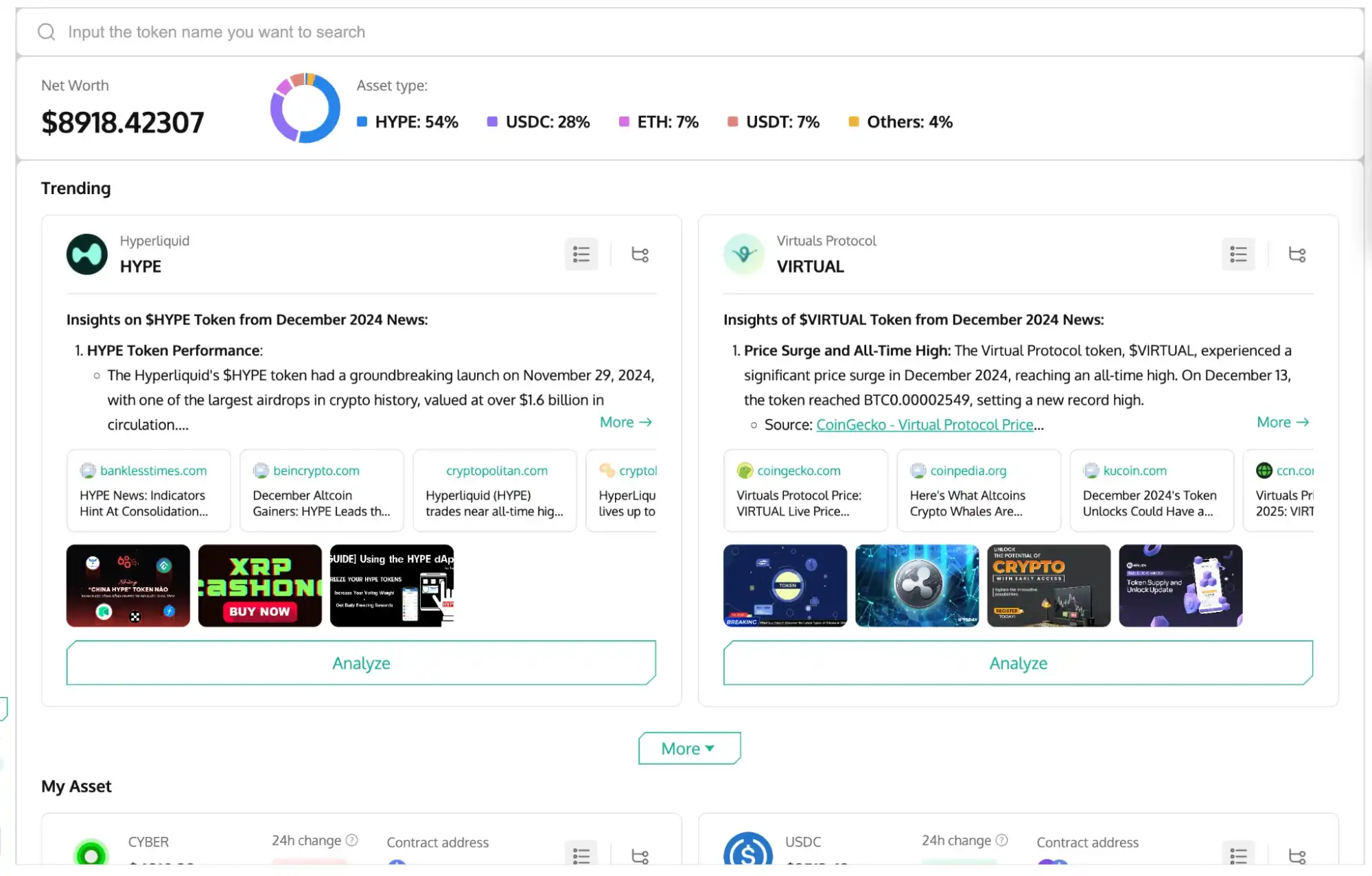
REVOX Lense is more like a "Web3 version of GPT", providing one-stop information integration and analysis for on-chain assets. Currently, REVOX Lense has attracted 17 million users and is the largest dApp on opBNB. REVOX Lense can be seamlessly integrated with the user's wallet, automatically identifying assets and displaying high-quality news, social media trends and discussions related to wallet assets. By integrating wallet data, REVOX Lense also aggregates information into a comprehensive report to provide users with a holistic view of their asset performance, market sentiment and potential future trends. It can also answer investment questions encountered by users in the existing market, provide professional answers, and help users make informed decisions about their asset portfolios.
REVOX SmartWallet

REVOX SmartWallet is an AI-driven self-hosted wallet that simplifies DeFi operations, solves complex staking and cross-chain problems, and allows ordinary users to easily enjoy high-yield opportunities. SmartWallet can connect user wallets to multiple blockchain networks and simplify access to crypto assets. As an AI-driven wallet, REVOX SmartWallet can realize AI-driven: · Multi-Dex token Swap: Instantly query the real-time exchange rates of most DEXs to ensure the best transaction rate; · Perpetual DEX: By screening the best protocol integration to obtain perpetual trading functions; · Multiple cross-bridge solutions: AI agents provide the most cost-effective seamless cross-bridge recommendations.
REVOX Studio
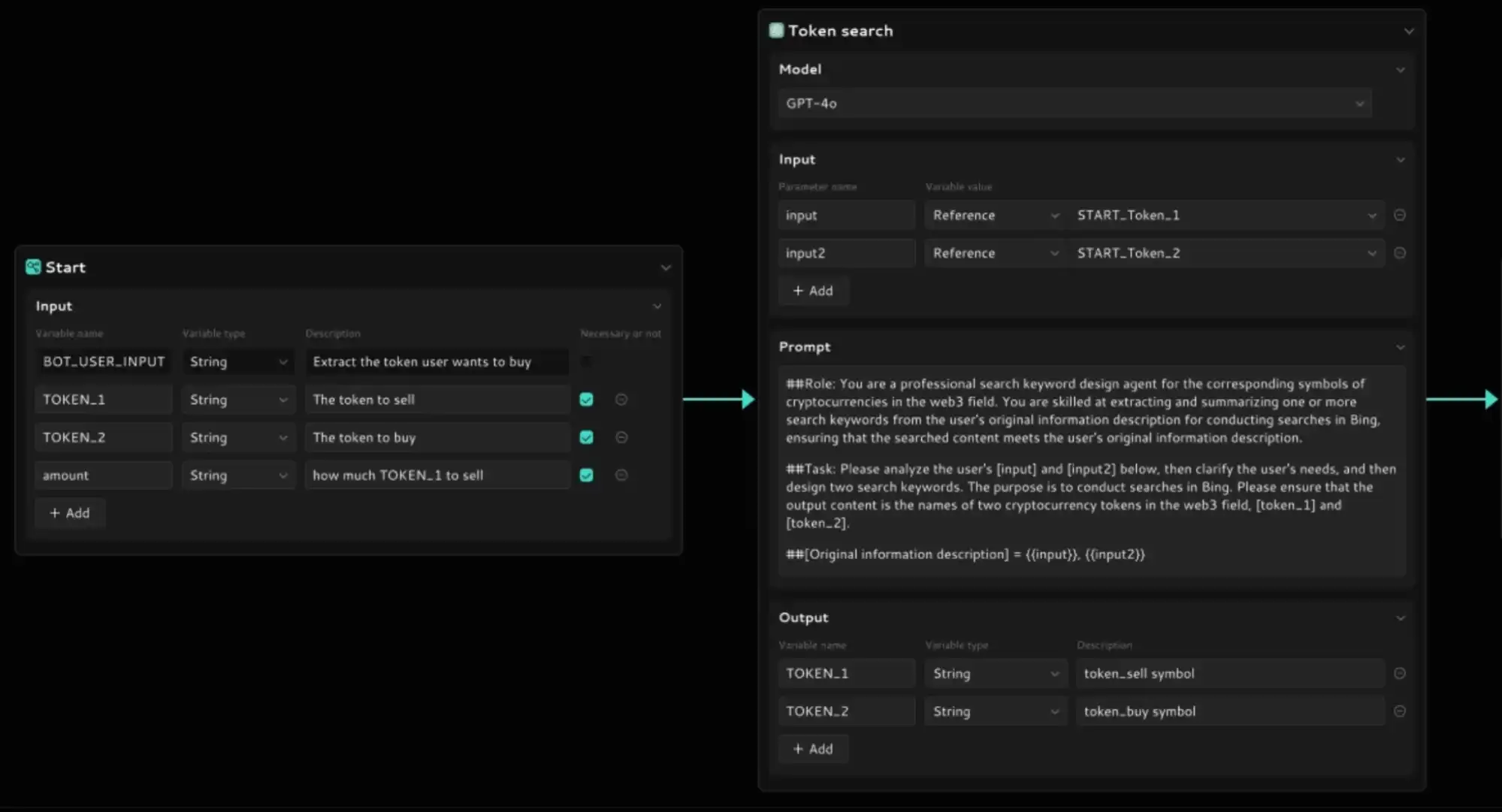

REVOX Studio is the core low-code development platform of the REVOX ecosystem. It provides developers with a powerful and user-friendly environment for building, deploying and managing decentralized AI applications. With its diverse plug-in library and integrated agent market, REVOX Studio enables developers to create complex AI agents and applications that can interact seamlessly with Web3 protocols.
The main features of REVOX Studio are:
· Low-code development: Simplifies the creation of AI+Web3 applications, which can also be used by low-level developers.
· Agent Market: Facilitates the sharing and monetization of AI Agents.
· Integration with Web3: AI agents on its market can perform on-chain transactions and interact with smart contracts.
· Rich plugin library: Provides pre-built plugins to speed up development.
For example: users can click to enter the REVOX Studio interface and search for available AI agents and plug-ins. In addition, users can also create AI agents themselves in its interface.
III. Major milestones and financing background, REVOX rises strongly
In addition to REVOX's products, its financing and background are also good:
In August 2022, REVOX (formerly ReadON) completed a $2 million seed round of financing led by SevenX Ventures, with HashKey Capital and others participating.
In March 2023, REVOX was selected as the third prize for the best social dApp in BNB Chain Connected 2023.
In June 2024, REVOX announced the completion of a strategic round of financing, with SevenX Ventures, Arweave SCP Ventures, Cointelegraph Acceleration, Skyland Ventures, Taisu Ventures, 0x Consulting, 7 upDAO and other institutions participating.
In July 2024, REVOX ranked first in the number of independent active addresses in the entire domain, and the second to fourth places were: Raydium, Hot Protocol, Uniswap, and UXLINK. At present, its total number of users has exceeded 21 million, making it a representative project of the Web3 AI ecosystem and one of the largest AI projects in the BNB Chain ecosystem.
In October 2024, REVOX was selected for the eighth season of the Binance Labs MVB Accelerator Program. REVOX has deployed AI encryption applications such as Lense and Smart Wallet in the BNB Chain ecosystem to help users complete multi-chain wallet connection and management, on-chain assets and off-chain data access, complex DeFi process transactions and other operations through AI.
In addition, REVOX is also the winner of the Solana Riptide Global Hackathon Community Award and the first prize winner of the Web3 Infra Hackathon sponsored by Arweave.
IV. REX's Token Economy and Roadmap
Token Economy: Stake-to-AI economic model, providing fuel for AI Agent. Staking REX to obtain AI points, rewarding long-term holders with ecological incentives
Basic Information: Governance token REX, total supply: 3 billion
Community airdrop: 10%, unlocked at TGE
Community staking and future incentives: 50%, unlocked in 6 months Cliff, unlocked linearly in 4 years
Liquidity + Marketing: 5%, unlocked at TGE
Team and advisors: 15%, unlocked in 6 months Cliff, unlocked linearly in 4 years
Investors: 20%, unlocked in 6 months Cliff, unlocked linearly in 2 years
REX can play a core role in platform governance, payments, and ecosystem rewards. Including, for payment of fees, REVOX's core products (such as Lense, SmartWallet, Studio, Agent Marketplace) and third-party products that support REVOX AI payments all accept REX as a payment method. Using REX to pay can enjoy discounts based on dynamic prices.
In addition, users can also stake REX as sREX and participate in multiple interests in the REVOX ecosystem to obtain ecosystem rewards. REX and sREX support 1: 1 redemption.
The core uses of sREX tokens include:
· sREX holders receive AI service points based on their holdings every day, which can be used for REVOX's products and partner ecosystem;
· sREX holders can join the staking pool to receive additional rewards: within 180 days after TGE, the staking pool will be directly funded by the REVOX Foundation. After 180 days, the source of staking pool rewards is the deduction of tokens from foundation injections and short-term redemptions;
· Participate in token airdrops. For projects built in REVOX Studio or distributed in REVOX Marketplace, sREX holders will have the opportunity to receive airdropped tokens based on their level of participation and holdings.
· The design features of sREX make it:
1. It will not directly affect the price of REX;
2. Short-term holders will face a higher token deduction rate after unstaking, which can alleviate REX inflation;
3. The deducted tokens will incentivize long-term pledgers;
4. 50% of the deducted tokens will be permanently destroyed, increasing the return rate for long-term holders.
Its official data shows that REVOX will launch the REVOX AI MEME token tool and REVOX AI Agent market in Q1 2025.
V. Airdrop Rules and Collection
Airdrop Rules:
· Complete the KYC certification of the trading platform and provide UID and deposit address;
· NFT holders, the NFT snapshot time is December 5, 2024, 3-Star Catto NFT will receive basic rewards; 4-Star Catto NFT will receive enhanced rewards;
· REVOX Galxe loyalty points are greater than 499;
· ReadON APP participation: ReadON DAO points are greater than 99 (ReadON DAO points snapshot time is November 19, 2024); ReadON SBT level is higher than 2 (ReadON Points snapshot time is November 19, 2024 ); · REVOX Lense, Smart Wallet, Studio and Contenthub: REVOX points greater than 1999 (the snapshot time of REVOX points is December 7, 2024); REVOX premium points greater than 0; users who have obtained REVOX AI points (the snapshot time is November 19, 2024).
· Collection: Enter the airdrop website to check the number of tokens. REX will be sent to the user's bound trading platform account or wallet account.
VI. Conclusion
Former Coinbase CTO BalajiSrinivasan recently wrote that AI originated from academic research and large technology companies and has a high reputation; encryption technology originated from anonymous forums and Internet communities so it had a low reputation at first. However, AI makes everything easy to forge, while cryptography makes forgery difficult, and the reputations of the two may gradually converge. Although AI is widely recognized as an important technology with civilizational significance, the value of cryptography is underestimated, and the reputations of the two will gradually approach each other in the future. In addition, AI is essentially power-centralized, while Crypto represents decentralization, and there are very similar points between the two in terms of technology.
Of course, there are skeptics who say that the combination of "AI+Crypto" is just a temporary hype, and that crypto technology has not yet had a lasting impact or widespread application in the fields of entertainment, games, and social media. But this is exactly the problem that "AI+Crypto" can solve - Mass adoption of encryption. AI Agent has greatly reduced the threshold for users to enter Web3, and has also created greater possibilities for encryption to go mainstream. Previously, Tommy, co-founder of Delphi Digital, predicted that the total market value of AI+Crypto may grow from the current US$43 billion to more than US$250 billion. Many projects that have been developed for many years will be launched one after another, especially those intelligent tokens that cannot be built on traditional AI platforms (such as ChatGPT, etc.) will usher in explosive growth.
The entry of traditional venture capital into Crypto+AI, the rapid iteration and integration of Open AI technology, and the crypto-friendly policies after Trump took office will all promote the development of Crypto+AI in 2025. Just like the DeFi Summer in 2020, "AI+Crypto" may usher in the next DeFi Summer.
Therefore, the combination of AI and Crypto will become the core narrative of future technology. As a pioneer in AI Agent infrastructure, REVOX is gradually building an "operating system" that connects AI and the decentralized world, providing developers and users with a revolutionary intelligent experience.
You may also like

Token Cannot Compound, Where Is the Real Investment Opportunity?

February 6th Market Key Intelligence, How Much Did You Miss?

China's Central Bank and Eight Other Departments' Latest Regulatory Focus: Key Attention to RWA Tokenized Asset Risk
Foreword: Today, the People's Bank of China's website published the "Notice of the People's Bank of China, National Development and Reform Commission, Ministry of Industry and Information Technology, Ministry of Public Security, State Administration for Market Regulation, China Banking and Insurance Regulatory Commission, China Securities Regulatory Commission, State Administration of Foreign Exchange on Further Preventing and Dealing with Risks Related to Virtual Currency and Others (Yinfa [2026] No. 42)", the latest regulatory requirements from the eight departments including the central bank, which are basically consistent with the regulatory requirements of recent years. The main focus of the regulation is on speculative activities such as virtual currency trading, exchanges, ICOs, overseas platform services, and this time, regulatory oversight of RWA has been added, explicitly prohibiting RWA tokenization, stablecoins (especially those pegged to the RMB). The following is the full text:
To the people's governments of all provinces, autonomous regions, and municipalities directly under the Central Government, the Xinjiang Production and Construction Corps:
Recently, there have been speculative activities related to virtual currency and Real-World Assets (RWA) tokenization, disrupting the economic and financial order and jeopardizing the property security of the people. In order to further prevent and address the risks related to virtual currency and Real-World Assets tokenization, effectively safeguard national security and social stability, in accordance with the "Law of the People's Republic of China on the People's Bank of China," "Law of the People's Republic of China on Commercial Banks," "Securities Law of the People's Republic of China," "Law of the People's Republic of China on Securities Investment Funds," "Law of the People's Republic of China on Futures and Derivatives," "Cybersecurity Law of the People's Republic of China," "Regulations of the People's Republic of China on the Administration of Renminbi," "Regulations on Prevention and Disposal of Illegal Fundraising," "Regulations of the People's Republic of China on Foreign Exchange Administration," "Telecommunications Regulations of the People's Republic of China," and other provisions, after reaching consensus with the Cyberspace Administration of China, the Supreme People's Court, and the Supreme People's Procuratorate, and with the approval of the State Council, the relevant matters are notified as follows:
(I) Virtual currency does not possess the legal status equivalent to fiat currency. Virtual currencies such as Bitcoin, Ether, Tether, etc., have the main characteristics of being issued by non-monetary authorities, using encryption technology and distributed ledger or similar technology, existing in digital form, etc. They do not have legal tender status, should not and cannot be circulated and used as currency in the market.
The business activities related to virtual currency are classified as illegal financial activities. The exchange of fiat currency and virtual currency within the territory, exchange of virtual currencies, acting as a central counterparty in buying and selling virtual currencies, providing information intermediary and pricing services for virtual currency transactions, token issuance financing, and trading of virtual currency-related financial products, etc., fall under illegal financial activities, such as suspected illegal issuance of token vouchers, unauthorized public issuance of securities, illegal operation of securities and futures business, illegal fundraising, etc., are strictly prohibited across the board and resolutely banned in accordance with the law. Overseas entities and individuals are not allowed to provide virtual currency-related services to domestic entities in any form.
A stablecoin pegged to a fiat currency indirectly fulfills some functions of the fiat currency in circulation. Without the consent of relevant authorities in accordance with the law and regulations, any domestic or foreign entity or individual is not allowed to issue a RMB-pegged stablecoin overseas.
(II)Tokenization of Real-World Assets refers to the use of encryption technology and distributed ledger or similar technologies to transform ownership rights, income rights, etc., of assets into tokens (tokens) or other interests or bond certificates with token (token) characteristics, and carry out issuance and trading activities.
Engaging in the tokenization of real-world assets domestically, as well as providing related intermediary, information technology services, etc., which are suspected of illegal issuance of token vouchers, unauthorized public offering of securities, illegal operation of securities and futures business, illegal fundraising, and other illegal financial activities, shall be prohibited; except for relevant business activities carried out with the approval of the competent authorities in accordance with the law and regulations and relying on specific financial infrastructures. Overseas entities and individuals are not allowed to illegally provide services related to the tokenization of real-world assets to domestic entities in any form.
(III) Inter-agency Coordination. The People's Bank of China, together with the National Development and Reform Commission, the Ministry of Industry and Information Technology, the Ministry of Public Security, the State Administration for Market Regulation, the China Banking and Insurance Regulatory Commission, the China Securities Regulatory Commission, the State Administration of Foreign Exchange, and other departments, will improve the work mechanism, strengthen coordination with the Cyberspace Administration of China, the Supreme People's Court, and the Supreme People's Procuratorate, coordinate efforts, and overall guide regions to carry out risk prevention and disposal of virtual currency-related illegal financial activities.
The China Securities Regulatory Commission, together with the National Development and Reform Commission, the Ministry of Industry and Information Technology, the Ministry of Public Security, the People's Bank of China, the State Administration for Market Regulation, the China Banking and Insurance Regulatory Commission, the State Administration of Foreign Exchange, and other departments, will improve the work mechanism, strengthen coordination with the Cyberspace Administration of China, the Supreme People's Court, and the Supreme People's Procuratorate, coordinate efforts, and overall guide regions to carry out risk prevention and disposal of illegal financial activities related to the tokenization of real-world assets.
(IV) Strengthening Local Implementation. The people's governments at the provincial level are overall responsible for the prevention and disposal of risks related to virtual currencies and the tokenization of real-world assets in their respective administrative regions. The specific leading department is the local financial regulatory department, with participation from branches and dispatched institutions of the State Council's financial regulatory department, telecommunications regulators, public security, market supervision, and other departments, in coordination with cyberspace departments, courts, and procuratorates, to improve the normalization of the work mechanism, effectively connect with the relevant work mechanisms of central departments, form a cooperative and coordinated working pattern between central and local governments, effectively prevent and properly handle risks related to virtual currencies and the tokenization of real-world assets, and maintain economic and financial order and social stability.
(5) Enhanced Risk Monitoring. The People's Bank of China, China Securities Regulatory Commission, National Development and Reform Commission, Ministry of Industry and Information Technology, Ministry of Public Security, State Administration of Foreign Exchange, Cyberspace Administration of China, and other departments continue to improve monitoring techniques and system support, enhance cross-departmental data analysis and sharing, establish sound information sharing and cross-validation mechanisms, promptly grasp the risk situation of activities related to virtual currency and real-world asset tokenization. Local governments at all levels give full play to the role of local monitoring and early warning mechanisms. Local financial regulatory authorities, together with branches and agencies of the State Council's financial regulatory authorities, as well as departments of cyberspace and public security, ensure effective connection between online monitoring, offline investigation, and fund tracking, efficiently and accurately identify activities related to virtual currency and real-world asset tokenization, promptly share risk information, improve early warning information dissemination, verification, and rapid response mechanisms.
(6) Strengthened Oversight of Financial Institutions, Intermediaries, and Technology Service Providers. Financial institutions (including non-bank payment institutions) are prohibited from providing account opening, fund transfer, and clearing services for virtual currency-related business activities, issuing and selling financial products related to virtual currency, including virtual currency and related financial products in the scope of collateral, conducting insurance business related to virtual currency, or including virtual currency in the scope of insurance liability. Financial institutions (including non-bank payment institutions) are prohibited from providing custody, clearing, and settlement services for unauthorized real-world asset tokenization-related business and related financial products. Relevant intermediary institutions and information technology service providers are prohibited from providing intermediary, technical, or other services for unauthorized real-world asset tokenization-related businesses and related financial products.
(7) Enhanced Management of Internet Information Content and Access. Internet enterprises are prohibited from providing online business venues, commercial displays, marketing, advertising, or paid traffic diversion services for virtual currency and real-world asset tokenization-related business activities. Upon discovering clues of illegal activities, they should promptly report to relevant departments and provide technical support and assistance for related investigations and inquiries. Based on the clues transferred by the financial regulatory authorities, the cyberspace administration, telecommunications authorities, and public security departments should promptly close and deal with websites, mobile applications (including mini-programs), and public accounts engaged in virtual currency and real-world asset tokenization-related business activities in accordance with the law.
(8) Strengthened Entity Registration and Advertisement Management. Market supervision departments strengthen entity registration and management, and enterprise and individual business registrations must not contain terms such as "virtual currency," "virtual asset," "cryptocurrency," "crypto asset," "stablecoin," "real-world asset tokenization," or "RWA" in their names or business scopes. Market supervision departments, together with financial regulatory authorities, legally enhance the supervision of advertisements related to virtual currency and real-world asset tokenization, promptly investigating and handling relevant illegal advertisements.
(IX) Continued Rectification of Virtual Currency Mining Activities. The National Development and Reform Commission, together with relevant departments, strictly controls virtual currency mining activities, continuously promotes the rectification of virtual currency mining activities. The people's governments of various provinces take overall responsibility for the rectification of "mining" within their respective administrative regions. In accordance with the requirements of the National Development and Reform Commission and other departments in the "Notice on the Rectification of Virtual Currency Mining Activities" (NDRC Energy-saving Building [2021] No. 1283) and the provisions of the "Guidance Catalog for Industrial Structure Adjustment (2024 Edition)," a comprehensive review, investigation, and closure of existing virtual currency mining projects are conducted, new mining projects are strictly prohibited, and mining machine production enterprises are strictly prohibited from providing mining machine sales and other services within the country.
(X) Severe Crackdown on Related Illegal Financial Activities. Upon discovering clues to illegal financial activities related to virtual currency and the tokenization of real-world assets, local financial regulatory authorities, branches of the State Council's financial regulatory authorities, and other relevant departments promptly investigate, determine, and properly handle the issues in accordance with the law, and seriously hold the relevant entities and individuals legally responsible. Those suspected of crimes are transferred to the judicial authorities for processing according to the law.
(XI) Severe Crackdown on Related Illegal and Criminal Activities. The Ministry of Public Security, the People's Bank of China, the State Administration for Market Regulation, the China Banking and Insurance Regulatory Commission, the China Securities Regulatory Commission, as well as judicial and procuratorial organs, in accordance with their respective responsibilities, rigorously crack down on illegal and criminal activities related to virtual currency, the tokenization of real-world assets, such as fraud, money laundering, illegal business operations, pyramid schemes, illegal fundraising, and other illegal and criminal activities carried out under the guise of virtual currency, the tokenization of real-world assets, etc.
(XII) Strengthen Industry Self-discipline. Relevant industry associations should enhance membership management and policy advocacy, based on their own responsibilities, advocate and urge member units to resist illegal financial activities related to virtual currency and the tokenization of real-world assets. Member units that violate regulatory policies and industry self-discipline rules are to be disciplined in accordance with relevant self-regulatory management regulations. By leveraging various industry infrastructure, conduct risk monitoring related to virtual currency, the tokenization of real-world assets, and promptly transfer issue clues to relevant departments.
(XIII) Without the approval of relevant departments in accordance with the law and regulations, domestic entities and foreign entities controlled by them may not issue virtual currency overseas.
(XIV) Domestic entities engaging directly or indirectly in overseas external debt-based tokenization of real-world assets, or conducting asset securitization activities abroad based on domestic ownership rights, income rights, etc. (hereinafter referred to as domestic equity), should be strictly regulated in accordance with the principles of "same business, same risk, same rules." The National Development and Reform Commission, the China Securities Regulatory Commission, the State Administration of Foreign Exchange, and other relevant departments regulate it according to their respective responsibilities. For other forms of overseas real-world asset tokenization activities based on domestic equity by domestic entities, the China Securities Regulatory Commission, together with relevant departments, supervise according to their division of responsibilities. Without the consent and filing of relevant departments, no unit or individual may engage in the above-mentioned business.
(15) Overseas subsidiaries and branches of domestic financial institutions providing Real World Asset Tokenization-related services overseas shall do so legally and prudently. They shall have professional personnel and systems in place to effectively mitigate business risks, strictly implement customer onboarding, suitability management, anti-money laundering requirements, and incorporate them into the domestic financial institutions' compliance and risk management system. Intermediaries and information technology service providers offering Real World Asset Tokenization services abroad based on domestic equity or conducting Real World Asset Tokenization business in the form of overseas debt for domestic entities directly or indirectly venturing abroad must strictly comply with relevant laws and regulations. They should establish and improve relevant compliance and internal control systems in accordance with relevant normative requirements, strengthen business and risk control, and report the business developments to the relevant regulatory authorities for approval or filing.
(16) Strengthen organizational leadership and overall coordination. All departments and regions should attach great importance to the prevention of risks related to virtual currencies and Real World Asset Tokenization, strengthen organizational leadership, clarify work responsibilities, form a long-term effective working mechanism with centralized coordination, local implementation, and shared responsibilities, maintain high pressure, dynamically monitor risks, effectively prevent and mitigate risks in an orderly and efficient manner, legally protect the property security of the people, and make every effort to maintain economic and financial order and social stability.
(17) Widely carry out publicity and education. All departments, regions, and industry associations should make full use of various media and other communication channels to disseminate information through legal and policy interpretation, analysis of typical cases, and education on investment risks, etc. They should promote the illegality and harm of virtual currencies and Real World Asset Tokenization-related businesses and their manifestations, fully alert to potential risks and hidden dangers, and enhance public awareness and identification capabilities for risk prevention.
(18) Engaging in illegal financial activities related to virtual currencies and Real World Asset Tokenization in violation of this notice, as well as providing services for virtual currencies and Real World Asset Tokenization-related businesses, shall be punished in accordance with relevant regulations. If it constitutes a crime, criminal liability shall be pursued according to the law. For domestic entities and individuals who knowingly or should have known that overseas entities illegally provided virtual currency or Real World Asset Tokenization-related services to domestic entities and still assisted them, relevant responsibilities shall be pursued according to the law. If it constitutes a crime, criminal liability shall be pursued according to the law.
(19) If any unit or individual invests in virtual currencies, Real World Asset Tokens, and related financial products against public order and good customs, the relevant civil legal actions shall be invalid, and any resulting losses shall be borne by them. If there are suspicions of disrupting financial order and jeopardizing financial security, the relevant departments shall deal with them according to the law.
This notice shall enter into force upon the date of its issuance. The People's Bank of China and ten other departments' "Notice on Further Preventing and Dealing with the Risks of Virtual Currency Trading Speculation" (Yinfa [2021] No. 237) is hereby repealed.

Former Partner's Perspective on Multicoin: Kyle's Exit, But the Game He Left Behind Just Getting Started

Why Bitcoin Is Falling Now: The Real Reasons Behind BTC's Crash & WEEX's Smart Profit Playbook
Bitcoin's ongoing crash explained: Discover the 5 hidden triggers behind BTC's plunge & how WEEX's Auto Earn and Trade to Earn strategies help traders profit from crypto market volatility.

Wall Street's Hottest Trades See Exodus

Vitalik Discusses Ethereum Scaling Path, Circle Announces Partnership with Polymarket, What's the Overseas Crypto Community Talking About Today?

Believing in the Capital Markets - The Essence and Core Value of Cryptocurrency

Polymarket's 'Weatherman': Predict Temperature, Win Million-Dollar Payout

$15K+ Profits: The 4 AI Trading Secrets WEEX Hackathon Prelim Winners Used to Dominate Volatile Crypto Markets
How WEEX Hackathon's top AI trading strategies made $15K+ in crypto markets: 4 proven rules for ETH/BTC trading, market structure analysis, and risk management in volatile conditions.

A nearly 20% one-day plunge, how long has it been since you last saw a $60,000 Bitcoin?

Raoul Pal: I've seen every single panic, and they are never the end.

Key Market Information Discrepancy on February 6th - A Must-Read! | Alpha Morning Report

2026 Crypto Industry's First Snowfall
The Harsh Reality Behind the $26 Billion Crypto Liquidation: Liquidity Is Killing the Market
Why Is Gold, US Stocks, Bitcoin All Falling?

Key Market Intelligence for February 5th, how much did you miss out on?

Wintermute: By 2026, crypto had gradually become the settlement layer of the Internet economy
Token Cannot Compound, Where Is the Real Investment Opportunity?
February 6th Market Key Intelligence, How Much Did You Miss?
China's Central Bank and Eight Other Departments' Latest Regulatory Focus: Key Attention to RWA Tokenized Asset Risk
Foreword: Today, the People's Bank of China's website published the "Notice of the People's Bank of China, National Development and Reform Commission, Ministry of Industry and Information Technology, Ministry of Public Security, State Administration for Market Regulation, China Banking and Insurance Regulatory Commission, China Securities Regulatory Commission, State Administration of Foreign Exchange on Further Preventing and Dealing with Risks Related to Virtual Currency and Others (Yinfa [2026] No. 42)", the latest regulatory requirements from the eight departments including the central bank, which are basically consistent with the regulatory requirements of recent years. The main focus of the regulation is on speculative activities such as virtual currency trading, exchanges, ICOs, overseas platform services, and this time, regulatory oversight of RWA has been added, explicitly prohibiting RWA tokenization, stablecoins (especially those pegged to the RMB). The following is the full text:
To the people's governments of all provinces, autonomous regions, and municipalities directly under the Central Government, the Xinjiang Production and Construction Corps:
Recently, there have been speculative activities related to virtual currency and Real-World Assets (RWA) tokenization, disrupting the economic and financial order and jeopardizing the property security of the people. In order to further prevent and address the risks related to virtual currency and Real-World Assets tokenization, effectively safeguard national security and social stability, in accordance with the "Law of the People's Republic of China on the People's Bank of China," "Law of the People's Republic of China on Commercial Banks," "Securities Law of the People's Republic of China," "Law of the People's Republic of China on Securities Investment Funds," "Law of the People's Republic of China on Futures and Derivatives," "Cybersecurity Law of the People's Republic of China," "Regulations of the People's Republic of China on the Administration of Renminbi," "Regulations on Prevention and Disposal of Illegal Fundraising," "Regulations of the People's Republic of China on Foreign Exchange Administration," "Telecommunications Regulations of the People's Republic of China," and other provisions, after reaching consensus with the Cyberspace Administration of China, the Supreme People's Court, and the Supreme People's Procuratorate, and with the approval of the State Council, the relevant matters are notified as follows:
(I) Virtual currency does not possess the legal status equivalent to fiat currency. Virtual currencies such as Bitcoin, Ether, Tether, etc., have the main characteristics of being issued by non-monetary authorities, using encryption technology and distributed ledger or similar technology, existing in digital form, etc. They do not have legal tender status, should not and cannot be circulated and used as currency in the market.
The business activities related to virtual currency are classified as illegal financial activities. The exchange of fiat currency and virtual currency within the territory, exchange of virtual currencies, acting as a central counterparty in buying and selling virtual currencies, providing information intermediary and pricing services for virtual currency transactions, token issuance financing, and trading of virtual currency-related financial products, etc., fall under illegal financial activities, such as suspected illegal issuance of token vouchers, unauthorized public issuance of securities, illegal operation of securities and futures business, illegal fundraising, etc., are strictly prohibited across the board and resolutely banned in accordance with the law. Overseas entities and individuals are not allowed to provide virtual currency-related services to domestic entities in any form.
A stablecoin pegged to a fiat currency indirectly fulfills some functions of the fiat currency in circulation. Without the consent of relevant authorities in accordance with the law and regulations, any domestic or foreign entity or individual is not allowed to issue a RMB-pegged stablecoin overseas.
(II)Tokenization of Real-World Assets refers to the use of encryption technology and distributed ledger or similar technologies to transform ownership rights, income rights, etc., of assets into tokens (tokens) or other interests or bond certificates with token (token) characteristics, and carry out issuance and trading activities.
Engaging in the tokenization of real-world assets domestically, as well as providing related intermediary, information technology services, etc., which are suspected of illegal issuance of token vouchers, unauthorized public offering of securities, illegal operation of securities and futures business, illegal fundraising, and other illegal financial activities, shall be prohibited; except for relevant business activities carried out with the approval of the competent authorities in accordance with the law and regulations and relying on specific financial infrastructures. Overseas entities and individuals are not allowed to illegally provide services related to the tokenization of real-world assets to domestic entities in any form.
(III) Inter-agency Coordination. The People's Bank of China, together with the National Development and Reform Commission, the Ministry of Industry and Information Technology, the Ministry of Public Security, the State Administration for Market Regulation, the China Banking and Insurance Regulatory Commission, the China Securities Regulatory Commission, the State Administration of Foreign Exchange, and other departments, will improve the work mechanism, strengthen coordination with the Cyberspace Administration of China, the Supreme People's Court, and the Supreme People's Procuratorate, coordinate efforts, and overall guide regions to carry out risk prevention and disposal of virtual currency-related illegal financial activities.
The China Securities Regulatory Commission, together with the National Development and Reform Commission, the Ministry of Industry and Information Technology, the Ministry of Public Security, the People's Bank of China, the State Administration for Market Regulation, the China Banking and Insurance Regulatory Commission, the State Administration of Foreign Exchange, and other departments, will improve the work mechanism, strengthen coordination with the Cyberspace Administration of China, the Supreme People's Court, and the Supreme People's Procuratorate, coordinate efforts, and overall guide regions to carry out risk prevention and disposal of illegal financial activities related to the tokenization of real-world assets.
(IV) Strengthening Local Implementation. The people's governments at the provincial level are overall responsible for the prevention and disposal of risks related to virtual currencies and the tokenization of real-world assets in their respective administrative regions. The specific leading department is the local financial regulatory department, with participation from branches and dispatched institutions of the State Council's financial regulatory department, telecommunications regulators, public security, market supervision, and other departments, in coordination with cyberspace departments, courts, and procuratorates, to improve the normalization of the work mechanism, effectively connect with the relevant work mechanisms of central departments, form a cooperative and coordinated working pattern between central and local governments, effectively prevent and properly handle risks related to virtual currencies and the tokenization of real-world assets, and maintain economic and financial order and social stability.
(5) Enhanced Risk Monitoring. The People's Bank of China, China Securities Regulatory Commission, National Development and Reform Commission, Ministry of Industry and Information Technology, Ministry of Public Security, State Administration of Foreign Exchange, Cyberspace Administration of China, and other departments continue to improve monitoring techniques and system support, enhance cross-departmental data analysis and sharing, establish sound information sharing and cross-validation mechanisms, promptly grasp the risk situation of activities related to virtual currency and real-world asset tokenization. Local governments at all levels give full play to the role of local monitoring and early warning mechanisms. Local financial regulatory authorities, together with branches and agencies of the State Council's financial regulatory authorities, as well as departments of cyberspace and public security, ensure effective connection between online monitoring, offline investigation, and fund tracking, efficiently and accurately identify activities related to virtual currency and real-world asset tokenization, promptly share risk information, improve early warning information dissemination, verification, and rapid response mechanisms.
(6) Strengthened Oversight of Financial Institutions, Intermediaries, and Technology Service Providers. Financial institutions (including non-bank payment institutions) are prohibited from providing account opening, fund transfer, and clearing services for virtual currency-related business activities, issuing and selling financial products related to virtual currency, including virtual currency and related financial products in the scope of collateral, conducting insurance business related to virtual currency, or including virtual currency in the scope of insurance liability. Financial institutions (including non-bank payment institutions) are prohibited from providing custody, clearing, and settlement services for unauthorized real-world asset tokenization-related business and related financial products. Relevant intermediary institutions and information technology service providers are prohibited from providing intermediary, technical, or other services for unauthorized real-world asset tokenization-related businesses and related financial products.
(7) Enhanced Management of Internet Information Content and Access. Internet enterprises are prohibited from providing online business venues, commercial displays, marketing, advertising, or paid traffic diversion services for virtual currency and real-world asset tokenization-related business activities. Upon discovering clues of illegal activities, they should promptly report to relevant departments and provide technical support and assistance for related investigations and inquiries. Based on the clues transferred by the financial regulatory authorities, the cyberspace administration, telecommunications authorities, and public security departments should promptly close and deal with websites, mobile applications (including mini-programs), and public accounts engaged in virtual currency and real-world asset tokenization-related business activities in accordance with the law.
(8) Strengthened Entity Registration and Advertisement Management. Market supervision departments strengthen entity registration and management, and enterprise and individual business registrations must not contain terms such as "virtual currency," "virtual asset," "cryptocurrency," "crypto asset," "stablecoin," "real-world asset tokenization," or "RWA" in their names or business scopes. Market supervision departments, together with financial regulatory authorities, legally enhance the supervision of advertisements related to virtual currency and real-world asset tokenization, promptly investigating and handling relevant illegal advertisements.
(IX) Continued Rectification of Virtual Currency Mining Activities. The National Development and Reform Commission, together with relevant departments, strictly controls virtual currency mining activities, continuously promotes the rectification of virtual currency mining activities. The people's governments of various provinces take overall responsibility for the rectification of "mining" within their respective administrative regions. In accordance with the requirements of the National Development and Reform Commission and other departments in the "Notice on the Rectification of Virtual Currency Mining Activities" (NDRC Energy-saving Building [2021] No. 1283) and the provisions of the "Guidance Catalog for Industrial Structure Adjustment (2024 Edition)," a comprehensive review, investigation, and closure of existing virtual currency mining projects are conducted, new mining projects are strictly prohibited, and mining machine production enterprises are strictly prohibited from providing mining machine sales and other services within the country.
(X) Severe Crackdown on Related Illegal Financial Activities. Upon discovering clues to illegal financial activities related to virtual currency and the tokenization of real-world assets, local financial regulatory authorities, branches of the State Council's financial regulatory authorities, and other relevant departments promptly investigate, determine, and properly handle the issues in accordance with the law, and seriously hold the relevant entities and individuals legally responsible. Those suspected of crimes are transferred to the judicial authorities for processing according to the law.
(XI) Severe Crackdown on Related Illegal and Criminal Activities. The Ministry of Public Security, the People's Bank of China, the State Administration for Market Regulation, the China Banking and Insurance Regulatory Commission, the China Securities Regulatory Commission, as well as judicial and procuratorial organs, in accordance with their respective responsibilities, rigorously crack down on illegal and criminal activities related to virtual currency, the tokenization of real-world assets, such as fraud, money laundering, illegal business operations, pyramid schemes, illegal fundraising, and other illegal and criminal activities carried out under the guise of virtual currency, the tokenization of real-world assets, etc.
(XII) Strengthen Industry Self-discipline. Relevant industry associations should enhance membership management and policy advocacy, based on their own responsibilities, advocate and urge member units to resist illegal financial activities related to virtual currency and the tokenization of real-world assets. Member units that violate regulatory policies and industry self-discipline rules are to be disciplined in accordance with relevant self-regulatory management regulations. By leveraging various industry infrastructure, conduct risk monitoring related to virtual currency, the tokenization of real-world assets, and promptly transfer issue clues to relevant departments.
(XIII) Without the approval of relevant departments in accordance with the law and regulations, domestic entities and foreign entities controlled by them may not issue virtual currency overseas.
(XIV) Domestic entities engaging directly or indirectly in overseas external debt-based tokenization of real-world assets, or conducting asset securitization activities abroad based on domestic ownership rights, income rights, etc. (hereinafter referred to as domestic equity), should be strictly regulated in accordance with the principles of "same business, same risk, same rules." The National Development and Reform Commission, the China Securities Regulatory Commission, the State Administration of Foreign Exchange, and other relevant departments regulate it according to their respective responsibilities. For other forms of overseas real-world asset tokenization activities based on domestic equity by domestic entities, the China Securities Regulatory Commission, together with relevant departments, supervise according to their division of responsibilities. Without the consent and filing of relevant departments, no unit or individual may engage in the above-mentioned business.
(15) Overseas subsidiaries and branches of domestic financial institutions providing Real World Asset Tokenization-related services overseas shall do so legally and prudently. They shall have professional personnel and systems in place to effectively mitigate business risks, strictly implement customer onboarding, suitability management, anti-money laundering requirements, and incorporate them into the domestic financial institutions' compliance and risk management system. Intermediaries and information technology service providers offering Real World Asset Tokenization services abroad based on domestic equity or conducting Real World Asset Tokenization business in the form of overseas debt for domestic entities directly or indirectly venturing abroad must strictly comply with relevant laws and regulations. They should establish and improve relevant compliance and internal control systems in accordance with relevant normative requirements, strengthen business and risk control, and report the business developments to the relevant regulatory authorities for approval or filing.
(16) Strengthen organizational leadership and overall coordination. All departments and regions should attach great importance to the prevention of risks related to virtual currencies and Real World Asset Tokenization, strengthen organizational leadership, clarify work responsibilities, form a long-term effective working mechanism with centralized coordination, local implementation, and shared responsibilities, maintain high pressure, dynamically monitor risks, effectively prevent and mitigate risks in an orderly and efficient manner, legally protect the property security of the people, and make every effort to maintain economic and financial order and social stability.
(17) Widely carry out publicity and education. All departments, regions, and industry associations should make full use of various media and other communication channels to disseminate information through legal and policy interpretation, analysis of typical cases, and education on investment risks, etc. They should promote the illegality and harm of virtual currencies and Real World Asset Tokenization-related businesses and their manifestations, fully alert to potential risks and hidden dangers, and enhance public awareness and identification capabilities for risk prevention.
(18) Engaging in illegal financial activities related to virtual currencies and Real World Asset Tokenization in violation of this notice, as well as providing services for virtual currencies and Real World Asset Tokenization-related businesses, shall be punished in accordance with relevant regulations. If it constitutes a crime, criminal liability shall be pursued according to the law. For domestic entities and individuals who knowingly or should have known that overseas entities illegally provided virtual currency or Real World Asset Tokenization-related services to domestic entities and still assisted them, relevant responsibilities shall be pursued according to the law. If it constitutes a crime, criminal liability shall be pursued according to the law.
(19) If any unit or individual invests in virtual currencies, Real World Asset Tokens, and related financial products against public order and good customs, the relevant civil legal actions shall be invalid, and any resulting losses shall be borne by them. If there are suspicions of disrupting financial order and jeopardizing financial security, the relevant departments shall deal with them according to the law.
This notice shall enter into force upon the date of its issuance. The People's Bank of China and ten other departments' "Notice on Further Preventing and Dealing with the Risks of Virtual Currency Trading Speculation" (Yinfa [2021] No. 237) is hereby repealed.
Former Partner's Perspective on Multicoin: Kyle's Exit, But the Game He Left Behind Just Getting Started
Why Bitcoin Is Falling Now: The Real Reasons Behind BTC's Crash & WEEX's Smart Profit Playbook
Bitcoin's ongoing crash explained: Discover the 5 hidden triggers behind BTC's plunge & how WEEX's Auto Earn and Trade to Earn strategies help traders profit from crypto market volatility.


 App
App