
- Buy Crypto
- Markets
 Futures
- Spot
- Copy Trade
- Earn
- More
Soros Predicts AI Bubble: We Live in a Self-Validating Market

Original Article Title: Busting the myth of efficient markets
Original Article Author: Byron Gilliam
Original Article Translation: AididiaoJP, Foresight News
How do financial markets, in turn, shape the reality they are supposed to measure?
There is a world of difference between rational 'knowing' and experiential 'understanding.' This is like reading a physics textbook versus watching "Mythbusters" blow up a water heater.
The textbook will tell you: heating water in a closed system will create hydraulic pressure due to water expansion.
You understand the theory of phase transitions from the text.
But "Mythbusters" shows you: how pressure can turn a water heater into a rocket, launching it 500 feet into the air.
You watch the video, and only then do you truly grasp what a catastrophic steam explosion looks like.
Visualization is often more impactful than narration.
Last week, Brian Armstrong gave us a live demonstration of George Soros's "reflexivity theory," an effect that would make the "Mythbusters" team proud.
During Coinbase's earnings call, after answering analysts' questions, Brian Armstrong read out an additional string of words. These were the words that market participants were betting he might say.
He concluded the call by saying: "I have been keeping an eye on the prediction markets for our earnings call. And now, I just wanted to add a few words: Bitcoin, Ethereum, Blockchain, Staking, and Web3."
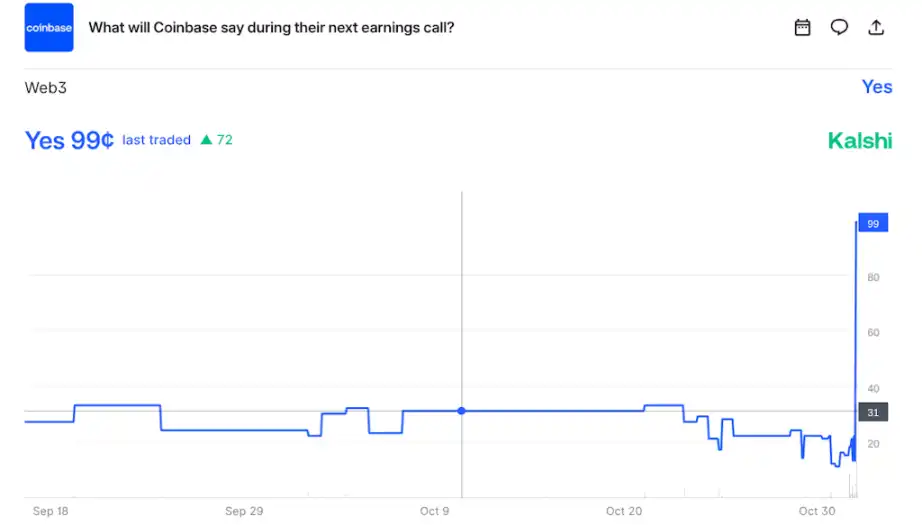
In my view, this vividly illustrates how most financial markets operate, just as George Soros's theory suggests: Market prices will affect the value of the assets they are pricing.
Before becoming a billionaire hedge fund manager, Soros aspired to be a philosopher. He attributed his success to identifying a flaw in the "efficient market theory": "Market prices always distort fundamentals."
Financial markets do not simply passively reflect the fundamentals of assets as traditionally understood; they actively shape the reality they are supposed to measure.
Soros gave the example of the 1960s conglomerate craze: Investors believed that these companies could create value by acquiring small, high-quality companies, driving up their stock prices. This, in turn, allowed these conglomerates to actually acquire these companies using their inflated stock prices, thus "realizing" value.
In short, this created a "sustained and circular" feedback loop: Participants' ideas influenced the events they were betting on, and these events, in turn, influenced their ideas.
Fast forward to today, Soros might give the example of a company like MicroStrategy. Its CEO, Michael Saylor, is pitching to investors exactly this circular logic: You should value MicroStrategy's stock at a premium to its net asset value because the very act of trading at a premium makes the stock more valuable.
In 2009, Soros wrote that he used reflexivity theory to analyze and pointed out that the root cause of the financial crisis was a fundamental misjudgment, namely, the belief that "(real estate) mortgage value is unrelated to credit availability."
The mainstream view was that banks simply overestimated the value of real estate serving as loan collateral, and investors paid too high a price for derivative products supported by these loans.
Sometimes that was indeed the case, just a simple mispricing of assets.
But Soros believed that the massive scale of the 2008 financial crisis had to be explained by a "feedback loop": Investors' high-price purchases of credit products drove up the value of the underlying collateral (real estate). "As credit becomes cheaper and more available, economic activity heats up, causing real estate values to rise."
And the rising real estate values, in turn, encouraged credit investors to pay a higher price.
In theory, credit derivative product prices such as CDOs should reflect real estate values. But in reality, they were also helping create these values.
That, at least, is the textbook explanation of Soros's theory of financial reflexivity.
But Brian Armstrong went beyond mere explanation; he demonstrated it in action, in the way of "The Rumor Terminator."
By speaking the words people were betting he would say, he proved that participants' views (predicting the market) could directly shape outcomes (what he actually said), precisely the meaning of Soros's statement that "market prices can distort fundamentals."
The current AI bubble is a trillion-dollar upgrade to Brian Armstrong's experiment, allowing us to grasp this lesson in real-time: People believe AGI will be achieved, so they invest in OpenAI, NVIDIA, data centers, and so on. These investments make AGI more likely to come true, which in turn attracts more investment in OpenAI...
This perfectly captures Soros's famous insight on bubbles: He would enter the market because his buying would drive up prices, and higher prices would improve fundamentals, attracting even more buyers.
However, Soros would also caution investors against believing in this self-fulfilling prophecy. In the extreme case of a bubble, the speed at which investors drive up prices far exceeds the speed at which prices can improve fundamentals.
Reflecting on the financial crisis, Soros wrote: "A complete reflexive process, initially self-reinforcing, must eventually reach a peak or turning point, after which it becomes self-reinforcing in the opposite direction."
In other words, trees don't grow to the sky, and bubbles don't last forever.
Unfortunately, there is no "MythBusters" type of experiment that can demonstrate this in real life.
But at least now we know that market prices can make things happen, just like a few words spoken on an earnings call.
So, why wouldn't AGI (Artificial General Intelligence) do the same?
You may also like

Crypto Price Prediction Today 18 February – XRP, Bitcoin, Ethereum
Key Takeaways XRP’s potential as a replacement for SWIFT is bolstered by regulatory approvals, potentially driving its price…

XRP Price Prediction: XRP is Outpacing Solana and Targeting Binance Coin Next – Should You Invest Now?
Key Takeaways XRP Ledger has moved into the sixth place by tokenized real-world asset value, surpassing Solana and…

New AI Predicts the Price of XRP, Dogecoin, and Solana By 2026
Key Takeaways ChatGPT anticipates significant price increases for XRP, Dogecoin, and Solana by the end of 2026. XRP…

Arthur Hayes Shares Two Scenarios for Bitcoin Price, Calling for a Major Crypto Rally
Key Takeaways Arthur Hayes predicts a significant crypto rally fueled by a $572 billion liquidity injection from the…

Bitcoin Price Prediction: Abu Dhabi Gov Funds Buy $1 Billion in BTC – What Do They Know?
Key Takeaways Abu Dhabi has revealed a $1 billion stake in Bitcoin through major ETF investments, signaling strong…

Bitcoin’s Divergence From Nasdaq Signals Dollar Liquidity Risk, Says Arthur Hayes
Key Takeaways Arthur Hayes highlights a concerning divergence between Bitcoin and the Nasdaq, pointing to a potential dollar…

Lagarde’s Possible Early Exit Could Alter Digital Euro Plans and Stablecoin Oversight
Key Takeaways Christine Lagarde’s potential departure as ECB president may disrupt the digital euro timeline and stablecoin policies.…
HYLQ Strategy Invests in Hyperliquid Quantum Solutions Pioneer qLABS, Acquires 18,333,334 qONE Tokens
Key Takeaways HYLQ Strategy Corp has made a strategic investment in qLABS, purchasing over 18 million qONE tokens…

WLFI Crypto Surges Toward $0.12 as Whale Purchase Precedes Trump-Linked Forum
Key Takeaways Whale accumulation has spurred a rally in WLFI crypto prices, reaching towards $0.12 ahead of a…
Cathie Wood Reverses Path with $6.9 Million Purchase in Coinbase Stock – Is ARK Strategizing a Rebound?
Key Takeaways ARK Invest acquires 41,453 shares of Coinbase, showing renewed interest post recent divestment. This acquisition by…
Crypto Lobby Establishes Working Group to Advocate for Prediction Market Regulatory Clarity
Key Takeaways The Digital Chamber announced the Prediction Markets Working Group to promote federal oversight of prediction markets.…

Peter Thiel Discreetly Withdraws from Ethereum Treasury Venture ETHZilla – A Cautionary Note for the DAT Model?
Key Takeaways Peter Thiel and Founders Fund have completely exited their position in ETHZilla. Thiel’s withdrawal raises questions…

Coin Center Advocates Protecting Crypto Developer Liability
Key Takeaways Coin Center is actively lobbying the U.S. Senate to safeguard crypto developer liability protections. The ongoing…

$150B in US Tax Refunds Could Catalyze Fresh Crypto Inflows, Historical Trends Indicate
Key Takeaways The IRS anticipates distributing approximately $150 billion in tax refunds to U.S. consumers by the end…

Oracle Error Leads DeFi Lender Moonwell to $1.8 Million in Bad Debt
Key Takeaways A critical oracle pricing glitch caused Moonwell to incur nearly $1.8 million in bad debt. The…
Crypto Price Prediction Today 18 February – XRP, Solana, Dogecoin
Key Takeaways XRP targets a $5 move, driven by its role as an alternative to SWIFT for cross-border…

China’s DeepSeek AI Predicts the Price of XRP, PEPE, and Shiba Inu By the End of 2026
Key Takeaways DeepSeek AI suggests significant potential price increases for XRP, PEPE, and Shiba Inu by 2026. XRP…

XRP Battles Key Support Amid Grayscale Sentiment Surge
Key Takeaways XRP has experienced a 29% price drop recently, creating a tense atmosphere among traders eyeing key…
Crypto Price Prediction Today 18 February – XRP, Bitcoin, Ethereum
Key Takeaways XRP’s potential as a replacement for SWIFT is bolstered by regulatory approvals, potentially driving its price…
XRP Price Prediction: XRP is Outpacing Solana and Targeting Binance Coin Next – Should You Invest Now?
Key Takeaways XRP Ledger has moved into the sixth place by tokenized real-world asset value, surpassing Solana and…
New AI Predicts the Price of XRP, Dogecoin, and Solana By 2026
Key Takeaways ChatGPT anticipates significant price increases for XRP, Dogecoin, and Solana by the end of 2026. XRP…
Arthur Hayes Shares Two Scenarios for Bitcoin Price, Calling for a Major Crypto Rally
Key Takeaways Arthur Hayes predicts a significant crypto rally fueled by a $572 billion liquidity injection from the…
Bitcoin Price Prediction: Abu Dhabi Gov Funds Buy $1 Billion in BTC – What Do They Know?
Key Takeaways Abu Dhabi has revealed a $1 billion stake in Bitcoin through major ETF investments, signaling strong…
Bitcoin’s Divergence From Nasdaq Signals Dollar Liquidity Risk, Says Arthur Hayes
Key Takeaways Arthur Hayes highlights a concerning divergence between Bitcoin and the Nasdaq, pointing to a potential dollar…


 App
App