
- Buy Crypto
- Markets
 Futures
- Spot
- Copy Trade
 Earn
Earn- More
Tether, which has "enriched" itself through stablecoins, is now heavily investing in AI

Original Title: "AI Industry, Here Comes Cash-Rich Tether"
Original Author: Kuri, Deep Tide TechFlow
Tether earned $13 billion in 2024.
This number may not mean much to you. Let's put it another way: OpenAI had $3.7 billion in revenue in 2024 but lost $5 billion. Anthropic had $1 billion in revenue but also lost $5 billion.
The combined losses of these two reputable AI companies are still less than what Tether earned in a year.
Tether has 150 employees, while OpenAI has over 3000 employees. The difference in per capita output is approximately:
60 times.
How does Tether make money? You buy 1 USDT for $1, they take that $1 and buy US Treasury bonds. The bond interest goes to them, not you.
The essence of this is that Tether does not pay interest. Banks have to pay interest on deposits, but Tether doesn't. When you exchange your money for USDT, holding it, you earn zero interest. They take your money to buy US Treasury bonds, and in 2024 alone, they earned $7 billion in interest.
With 150 people overseeing over $130 billion in Treasury bonds, they don't have to do anything, as the interest comes in by itself.
Anybody would want to take it easy with such a business.
But when you have a lot of money, you have to spend it somehow. Tether chose a direction:
AI.
And it's not just about randomly investing in a couple of projects.
Let's talk about computational power first.
AI computation requires GPUs, the more, the better, and the more expensive, the better. Tether provided a loan of over $600 million to a German company, Northern Data.
What does this company do?
It's Europe's largest GPU cloud service provider. With over ten thousand Nvidia H100 GPUs, the same type used by OpenAI to train GPT, each costing two to three thousand dollars.
This cluster of GPUs ranks 26th in the world's TOP500 supercomputers. The $600 million that Tether poured in is essentially buying an AI training base in Europe.
Talking Data.
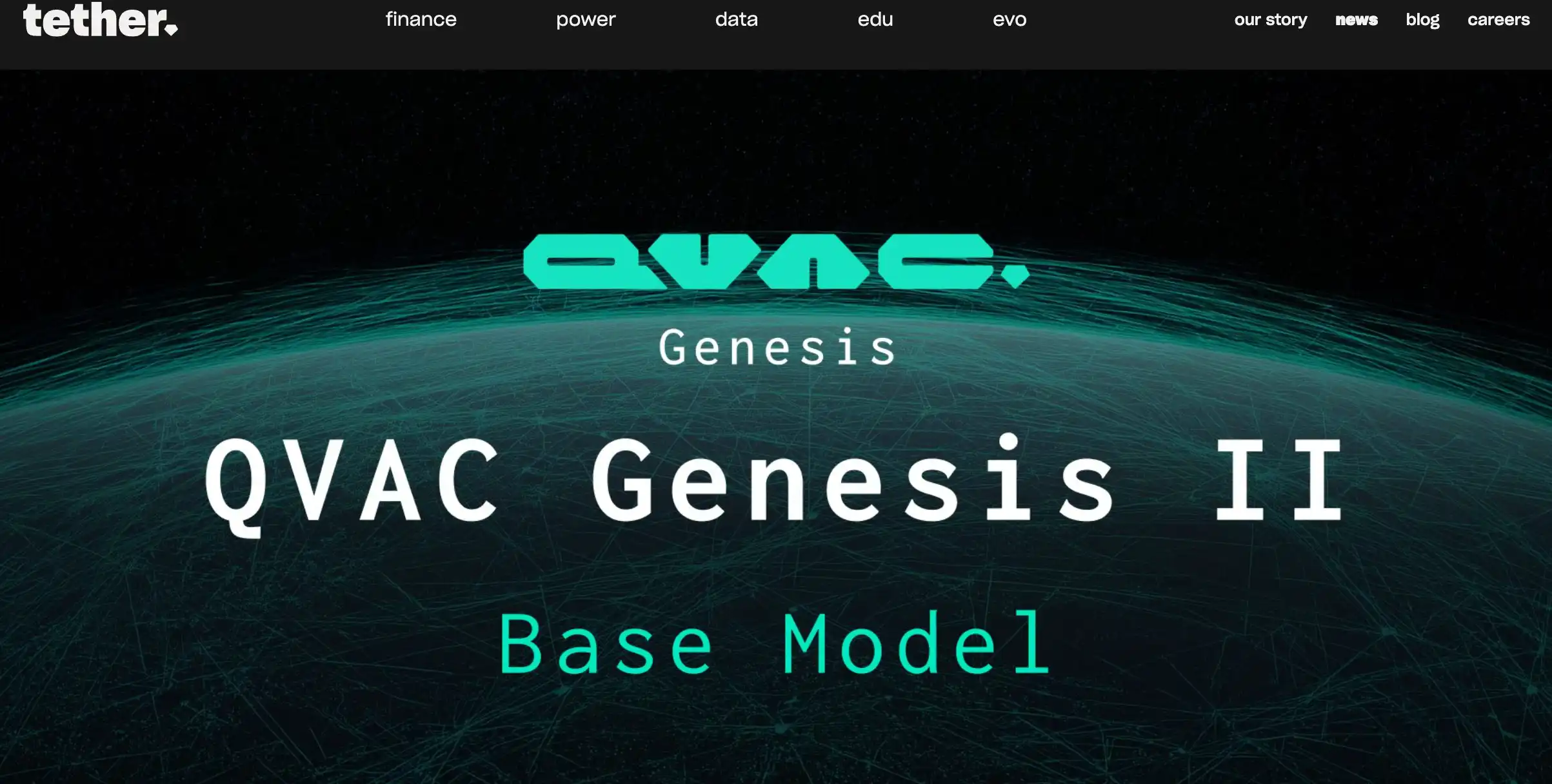
Training AI requires feeding data. Last week, Tether released a dataset called QVAC Genesis, covering 19 subjects including mathematics, physics, chemistry, and computer science. They claim it to be the world's largest open-source AI training data.
Note that the training data from OpenAI and Anthropic is not public, but Tether released theirs directly for free for anyone to use.
Now onto the more futuristic part.
In April 2024, Tether spent $200 million to acquire a company called Blackrock Neurotech. Despite the name similarities, it has no relation to BlackRock the asset manager.
This company works on brain-computer interfaces. They implant chips into people's brains, allowing paralyzed individuals to type with their mind, control wheelchairs, or operate robotic arms. It sounds like science fiction, but they started back in 2008, eight years before Musk's Neuralink.
How impressive is this company?
A total of 35 people globally have brain-computer interface chips, with 31 of them using Blackrock's technology. In 2016, a fully paralyzed patient controlled a robotic arm with their device and fist-bumped Obama. The chip in their sensory cortex allowed them to "feel" the President's hand.
Last year, this brain-computer interface company enabled an ALS patient to "speak" again, with the chip in their brain translating thoughts into speech at a rate of 62 words per minute.
Tether spent $200 million to become a major shareholder in this company.
Altogether, Tether has invested close to $1 billion in AI-related fields. It is said that they are also in talks to acquire a German robotics company for $1.2 billion. If successful, their total investment will approach $2 billion.
What does this mean?
Anthropic raised $35 billion in funding throughout 2024. The investment by Tether, from one company, is close to half of what a top-tier AI company raises.
OpenAI spent $6.7 billion on R&D in the first half of 2025. With the profits, Tether, with spare change, could play the role of a big daddy in the AI realm.
Why would a stablecoin issuer venture into AI?
We see two possibilities.
The first is anxiety. The Fed is cutting rates, bond yields are falling. Earning $7 billion in interest while lying down in 2024, things might not be as good from 2025 onwards. The money printer also needs a new narrative.
The second is ambition. The whole world is talking about AI—investors, the media, politicians. If you say you're a stablecoin company, no one pays much attention. But if you say you're working on AI, brain-machine interfaces, humanoid robots, then you are:
A technology leader.
But what's most amusing is this.
Tether is venturing into AI, chanting slogans like "decentralization," "on-device computation," and "returning intelligence to individuals."
But Tether, itself, is the most centralized company in the crypto world.
He decides when to issue coins, he decides the reserve amount. In its ten years of existence, it has never been audited. Only he knows where users' money is.
Now, this company wants to teach the world what "decentralized AI" means.
It's really quite like a casino owner offering classes on quitting gambling.
But it's not impossible.
After all, OpenAI is still losing money, projected to stop burning cash in 2029. Anthropic is in a similar situation, projected to break even in 2028. Sam Altman is fundraising everywhere, Dario Amodei is fundraising everywhere. These two companies together have lost $10 billion and are still storytelling to investors.
Tether doesn't need to do that. The money is already in his pocket.
What's the biggest challenge facing the entire AI industry? The business model.
How do you make money? Don't know. When will you make money? Don't know. Can you make money? Don't know.
Tether doesn't have this worry. His business model is simply:
Not doing AI.
The money earned from stablecoins is used to invest in AI. Making the right investment is foresight, making the wrong one is a tuition fee. In any case, it doesn't affect the core business.
Those doing AI are losing money, those not doing AI are making money. Those doing AI are fundraising, those not doing AI are investing.
The best AI business model in 2026 may be not doing AI at all.
Get your money printer right first.
You may also like

February 9th Market Key Intelligence, How Much Did You Miss?

After being questioned by Vitalik, L2s are collectively saying goodbye to the "cheap" era

WEEX AI Trading Hackathon Paris Workshop Reveals: How Retail Crypto Traders Can Outperform Hedge Funds
Witness how WEEX's Paris AI Trading Hackathon revealed AI's edge over human traders. Explore key strategies, live competition results & how to build your own AI trading bot.

U.S. Oil (USOR) Price Prediction 2026–2030
Key Takeaways U.S. Oil (USOR) is a speculative Solana-based crypto project that aims to index the United States…

USOR Surges on Meme Narrative Despite No Real-World Asset Backing
Key Takeaways: USOR, a Solana-based token, has seen a notable surge driven by speculative narratives rather than verifiable…

How to Buy U.S. Oil Reserve (USOR) Cryptocurrency
Key Takeaways U.S. Oil Reserve (USOR) is a Solana-based token primarily traded on decentralized exchanges (DEXs). Claims have…

USOR vs Oil ETFs: Understanding Why the ‘Oil Reserve’ Token Doesn’t Track Crude Prices
Key Takeaways The U.S. Oil Reserve (USOR) token has become noteworthy for its claims, yet it does not…

Trend Research Reduces Ether Holdings After Major Market Turbulence
Key Takeaways: Trend Research has significantly cut down its Ether holdings, moving over 404,000 ETH to exchanges recently.…
Investors Channel $258M into Crypto Startups Despite $2 Trillion Market Sell-Off
Key Takeaways: Investors pumped approximately $258 million into crypto startups in early February, highlighting continued support for blockchain-related…
NBA Star Giannis Antetokounmpo Becomes Shareholder in Prediction Market Kalshi
Key Takeaways: Giannis Antetokounmpo, the NBA’s two-time MVP, invests in the prediction market platform Kalshi as a shareholder.…

Arizona Home Invasion Targets $66 Million in Cryptocurrency: Two Teens Charged
Key Takeaways Two teenagers from California face serious felony charges for allegedly attempting to steal $66 million in…

El Salvador’s Bukele Approval Reaches Record 91.9% Despite Limited Bitcoin Use
Key Takeaways: El Salvador President Nayib Bukele enjoys a record high approval rating of 91.9% from his populace,…

Crypto Price Prediction for February 6: XRP, Dogecoin, and Shiba Inu’s Market Movements
Key Takeaways: The crypto market experienced a notable shift with Bitcoin’s significant surge, impacting altcoins like XRP, Dogecoin,…

China Restricts Unapproved Yuan-Pegged Stablecoins to Maintain Currency Stability
Key Takeaways: China’s central bank and seven government agencies have banned the issuance of yuan-pegged stablecoins abroad without…

Solana Price Prediction: $80 SOL Looks Scary – But Smart Money Just Signaled This Might Be the Bottom
Key Takeaways Despite Solana’s descent to $80, some traders find security as smart money enters the fray, suggesting…

XRP Price Prediction: Major Ledger Upgrade Quietly Activated – Why This Could Be the Most Bullish Signal Yet
Key Takeaways: The activation of the Permissioned Domains amendment on XRPL represents a significant development in XRP’s potential…

Dogecoin Price Prediction: Death Cross Confirmed as DOGE Falls Below $0.10 – Is DOGE Reaching Zero?
Key Takeaways The death cross event signals potential bearish trends for Dogecoin as its price dips under $0.10,…

Stablecoin Inflows Have Doubled to $98B Amid Selling Pressure
Key Takeaways Stablecoin inflows to crypto exchanges have surged to $98 billion, doubling previous levels amidst heightened market…
February 9th Market Key Intelligence, How Much Did You Miss?
After being questioned by Vitalik, L2s are collectively saying goodbye to the "cheap" era
WEEX AI Trading Hackathon Paris Workshop Reveals: How Retail Crypto Traders Can Outperform Hedge Funds
Witness how WEEX's Paris AI Trading Hackathon revealed AI's edge over human traders. Explore key strategies, live competition results & how to build your own AI trading bot.
U.S. Oil (USOR) Price Prediction 2026–2030
Key Takeaways U.S. Oil (USOR) is a speculative Solana-based crypto project that aims to index the United States…
USOR Surges on Meme Narrative Despite No Real-World Asset Backing
Key Takeaways: USOR, a Solana-based token, has seen a notable surge driven by speculative narratives rather than verifiable…
How to Buy U.S. Oil Reserve (USOR) Cryptocurrency
Key Takeaways U.S. Oil Reserve (USOR) is a Solana-based token primarily traded on decentralized exchanges (DEXs). Claims have…


 App
App